In the race to provide new media consumers branded content, how does one decide what to model that content after? With so many different burgeoning styles of content and platforms to distribute on, making a decision like this can be a daunting one.
The industry response to the new media paradigm shift has been like that of the parents of Gen Y and Z children, digital immigrants working double-time to be in the know and determine with some certainty what is “hip” in order to connect with their kids on an emotional level again.
Therein lies the key: emotion. The strongest connection an ad can make with a consumer is an emotional one. And while everyone looks forward for the solution to the emotional problem (think AR, interactive ads, etc.), many fail to look at the solution that’s right in front of them here and now: art as entertainment.
Let’s not forget why audiences have subjected themselves to interruptive ads for so long – to gain the emotional pleasures of whatever they sought to watch in between those interruptions. So why not give them a branded short-form experience to engage with in the same way?
Those who have gone all-in on this idea have reaped their share of rewards. H&M, Mercedes-Benz, Kenzo, BMW, and Lyft have all found important, poignant, and authentically artful stories to tell that successfully align with their brand, all while being moving and visually beautiful (they’re not lacking in views either, with a collective 23 million views across the aforementioned branded films).
Not only is art as entertainment viable, it’s familiar and acceptable to new media audiences, giving them an experience they want to engage with and approve of rather than one to disengage with and rebuke. Audiences choose to watch what they watch because they are looking to have an emotional experience, so why not give them one?
—
Watch for weekly news updates from Brand Storytelling in your inbox, and share this with other storytellers in your network.
Of course, if you’d like to contribute to the story, We’d love to hear from you. Email us!
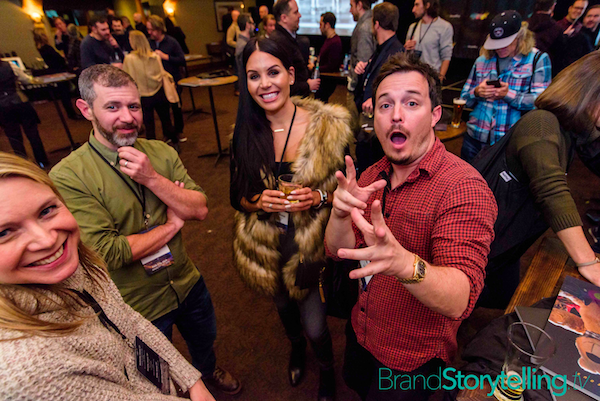
Brand Storytelling attendees celebrating opening night at the Turner Reception
Wednesday night marked the opening of Brand Storytelling: A Sanctioned Event of the 2018 Sundance Film Festival. As Park City gets ready for Sundance, the best and brightest creatives, brands, and agencies gathered to open this year’s celebration of the best brand-funded content, kicked off by an incredible welcome reception hosted by Turner Networks.
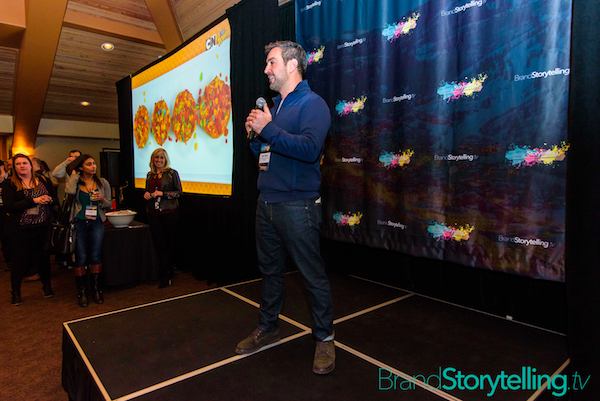
Dan Riess delivers opening remarks to the audience at the Turner Reception
Opening remarks from Rick Parkhill (Co-Founder & Director, Brand Storytelling) and Dan Riess (Executive Vice President of Content Partnerships, Turner) gave way to the Turner Brand Experience, which featured cocktails, conversation, confections, and collections of viewable media from TruTV, TBS, Super Deluxe, Great Big Story, CNN, Bleacher Report, and adult swim, all networks under the Turner umbrella. Guests mingled and engaged with interactive installations all while being treated to themed treats, drinks, and swag.
Thanks again to Turner for a wonderful start to a wonderful event.
—
Watch for weekly news updates from Brand Storytelling in your inbox by subscribing, and share this with other storytellers in your network.
Of course, if you’d like to contribute to the story, We’d love to hear from you. Email us!
Two years after the waters of Hurricane Harvey have subsided, tens of thousands of Texans have yet to rebuild their homes and businesses because of outdated and inefficient systems of recovery. Technologist Chelsey Delaney, personally connected to these events, believes she can help in the aftermath of a disaster to alleviate this burden for survivors.
IBM’s new film Bonds of Trust is an emotional glimpse into several intersecting aftermath stories and how the promise of blockchain technology can unite a response community of insurance providers, governments, and citizens to streamline the flow of information and resources to those who need it most.
Brand Storytelling sat down with IBM Chief Content Officer George Hammer to learn more about the upcoming film:
Coming off of last year’s film “Code and Response”, the “technology for good” theme that runs through the IBM films is apparent. Are there other content themes you might explore in the future?
IBM has been around for over 100 years because clients trust us to help them “get from here to there”. Our relationships are built on trust and so we have taken a stance on tech for good. Technology companies must act ethically, responsibly and with purpose. This is not a new theme for IBM. We have long believed that human plus machine is the right solution to build a smarter business and planet. So, “good” is not a campaign for us but it’s in our DNA.
If there is a sub-theme that you may see come to life more is equality. Last year we did launch an initiative called “Be Equal”. We have been and continue to champion gender equality in STEM.
What was the impetus behind focusing specifically on Hurricane Harvey in this film?
We were in a meeting and someone said that towns in Texas are still devastated years after Hurricane Harvey. We then learned that some IBMers built a solution using blockchain that could have helped the people in these towns recover much faster. Finally, we learned one of the IBMers is from one of those towns hit hard by the hurricane and her family lived through the storm.
We were compelled to tell the story. We didn’t want to just talk about the tech because we need people to care about the problem and demand a solution faster. So we decided to make a documentary and tell a more human-centric story. I hope audiences like it and seek to learn more about how blockchain can bring trust and transparency into any supply chain.
How does the content team fit within the organization? What’s the reporting structure for the team? Are you classified internally as marketing, PR, or something else altogether? Where does your budget fall?
The content team at IBM is in Marketing and reports up to the CMO. We are a discipline within overall marketing and not a silo group like an internal agency. That means we are embedded in every business unit, team and campaign. We have leads within each unit who band together like a guild and report to me. Then, we also have a production company with employees all around the world. All together we have between 400-700 content professionals depending if you are including contractors or not. We might be the biggest but we are tightly connected like a family. We also won over 90 awards for content in 2019 and I believe we have quality people making quality content and delivering upon a quality customer experience.
What comes next for the film? What are your distribution intentions? How will you drive viewership? Is there a paid media strategy for the film?
This is the premier and then it will be available to audiences via digital channels. We are not going to get into the distribution and media strategy but we have one.
What can guests of Brand Storytelling expect when they attend IBM’s screening next month in Deer Valley? Who will they meet at the screening?
You will get to see the film of course. But, our panel will include the people in the film and we are going to spend more time talking about how #TechForGood can make a difference. If you are a brand, come talk to us after about problems or ideas. If you are a media company, come talk with us about anything. If you are a director/producer, come talk with us about ideas related to this film or other ideas we might make together in the future. We look forward to meeting all at the screening or after during the happy hour.
—
Bonds of Trust will screen on Saturday, January 25th at Brand Storytelling 2020, a Sanctioned Event of Sundance Film Festival.
About George Hammer
George Hammer believes we are in the golden age of content, but face a war for attention. Today’s content has to be exceptional; platform agnostic and audience specific.As a data-driven storyteller, George’s mission is to unite brands and audiences with content that builds relationships and drives action.George and his team of content experts work together to develop content programs and strategies that connect IBM with its audiences and provides the information and tools they desire.His mission is to build the best content team in the world. He leads Content at tIBM and the award winning IBM Originals.
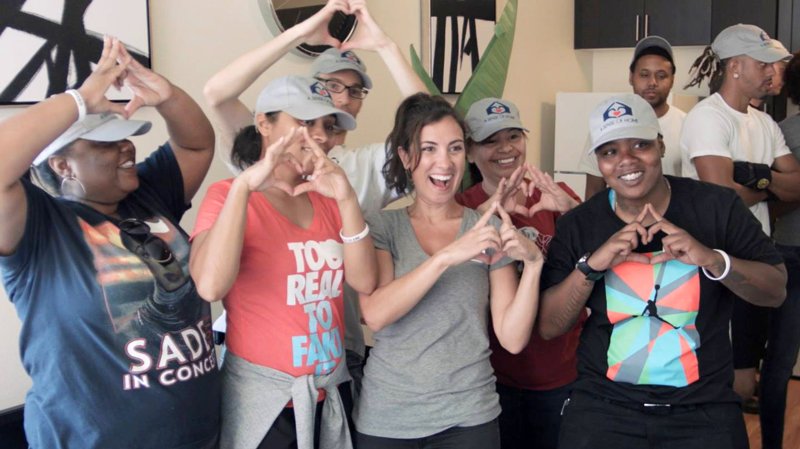
Many of you know my friend, AJ Vernett, a veteran of the digital video industry. Today, he is better known as the Co-Founder of A Sense of Home, a non-profit with a unique mission to help foster kids that are aging out of the system. “A Sense of Home” helps find places for these kids to live and furnish them in a way that turns that place into a home, something they have been denied most of their lives. In just 2 years, 150 homes have been created for 200 youth who finally have a place they can find comfort coming home to.
If you watched the live broadcast of CNN Heroes last night, you learned of the important work “A Sense of Home” is tackling that will literally save the lives of these kids in the most transitional stage of their lives. To understand the importance of their work, just watch this CNN profile of Sense of Home that features director and co-founder Georgie Smith:
Here at BrandStorytelling.tv, we love a good story. We love this one so much, we are jumping into the storyline ourselves and intend to play a role that will help give kids a better chance, and create thousands of stories of lives made better. You can too!
Creating a home for someone alone in the world, isn’t just vital to their survival; it’s a bridge —connecting them to community to ensure they have access to opportunity in order that they might fully realize their talents and skills and become the best version of themselves. Every day brings about another story of hope and about creating a beautiful inspired environment.
Every one of us can play a role in this unfolding story right now. You can simply go to A Sense of Home and make a donation today. When you do, Subaru will match your donation up to $50,000 between now and December 31, 2016.
Here’s a great way to get your company into the story; sponsor an event for $5,000 or more and send your team to help create that home alongside “A Sense of Home” staff. Be there when the kids get to see what you have done to provide them with a place they will call home. That’s a great story and there are roles for all of us!
I hope you will join us in this story and help these young-ones discover a better tomorrow.
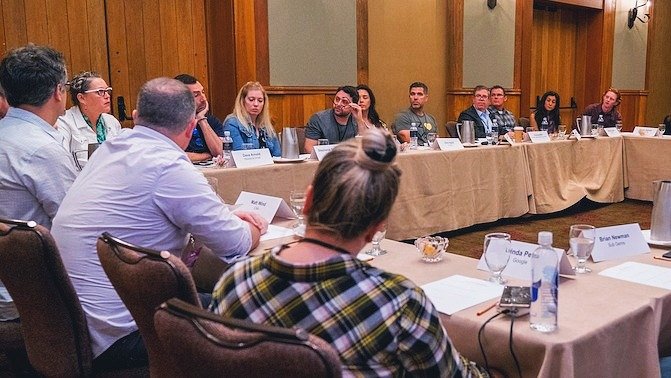
Elevate, the industry-building retreat for brand marketers and their partners, was designed to address the opportunities and challenges facing marketers in a media environment where interruption is increasingly less effective. The Elevate Trails addressed these opportunities and challenges, each featuring a group of hand-selected advisors and partners whose strengths lie in the investment, support, distribution, and measurement of brand-funded content. Each of these topics was introduced and discussed on stage by an expert panel, followed by breakout sessions in which small group conversations amongst industry leaders aimed at developing best practices, strategies and tactics took place.
I took the opportunity to sit in on these discussions and hear what the people at the heart of the content marketing world are really talking about, from what excites them to what’s holding them back and everything in between. The following is a distillation of the discussions on the subjects of investment and support into the most salient points necessary for brand marketers to be effective in their pursuit of creating effective brand-funded content for a marketing purpose.
As interruptive messaging becomes less effective, how do we choose what to invest in? How do we evaluate content, formats, medium? This discussion focused on how to make the right investment decisions. There are a lot of choices out there for marketers with constant innovation and an ever-expanding palette of mediums and formats – contributors discussed how to evaluate the landscape, from content types and formats to partners and platforms:
Last year, conversations revolved around 6 second video and keeping content short. But in that time, things have changed. Today, more brands and creatives are getting away from social only bite-size video and are focused instead on longer form “legitimate” content.
While format and platform trends have changed, the content goal remains the same: to connect emotionally with the consumer.
An idea alone is not enough to present when seeking investment
Doubling down on data at the investment stage brings strength to a pitch.
Measuring performance and recycling it back into data collection can provide long-term value for additional projects.
Building in a monetization component will appeal to the C-suite as well as improve the ability to measure content performance upon completion.
Leading with what you intend to measure and how by setting objectives and KPIs is essential when pitching the C-suite.
Be clear upfront – brand-funded content and commercials are not the same, and therefore shouldn’t be budgeted the same way.
Setting clear intentions about the content itself will help justify costs, high or low as they may be.
The emergence of new creative shops is matched by the number of in-house teams being developed, and with that the internal debate about what gets done in-house and what gets contracted out is likely to occur. The decision can be tough but should be made on a case-by-case basis.
Putting TV spots online isn’t enough.
Content should be designed for where it intends to live and should be invested in as such.
Direct-to-social, OTT, etc. should be planned for and invested in expressly from the outset.
The old adage still applies – you have to spend money to make money.
Appropriate early investment with intent to spend on amplification is important.
Specify your audience.
Identify your brand’s “fandom” and build an investment and content strategy around it.
Although the trend has swung in favor of longer form content, the debate over long form vs. short form content is inevitable.
Consider the shelf life of the content being produced as well as the half-life of the distribution platform when making this choice.
Short-term content strategy and investment may require an appeal to the C-suite, but times are changing and so is leadership. Long term content plans may very well outlast the C-suite.
Don’t forget that brands have power in the rights and production process, more than many realize.
How are brands building their internal teams and how do they expect their external teams to be staffed? How do we look at human capital in the face of efficiency from both a cost and time perspective? This discussion revolved around organizing content, creativity, and how brand stories are planned for and produced in the new world of people, platforms and technology, understanding the opportunities and challenges that executives face internally as much as externally, and ways to frame the best approach for brands:
Know your audience: when troubleshooting perception problems, a better explanation of the audience is required.
A misunderstanding of the target audience could result in not winding up with an RFP.
At the end of the day, people want to work with companies that share their values.
Look to find common ground early and establish it.
Know the difference between collaborating and meddling and call it out when you see it (constructively, of course).
This tends to happen when brands and creatives collaborate in the pre-production phase.
The key is to identify and diffuse the situation. Try giving the “meddling” party something relatively inconsequential overall but pertinent in the moment to focus on so that they get their win.
The support step can be simple when everyone on board is of the current culture, but often times agencies and other groups are still coming from the world of traditional advertising, television, etc.
Brands and agencies alike need to stop approaching collaborations from the television point of view and see the multifaceted new media landscape for what it is. Help them do this.
Build great arguments – utilize the news, data trends, examples of partnerships or other brands to help the c-suite and agency partners see the value in and bet on branded content.
When outfitting a creative team, pull in support from your personal connections.
Seek talent that aligns with your creative and marketing vision for achieving brand-funded content for a marketing purpose.
Take control of the situation by exercising aggressive prioritization in order to do the best of what needs getting done more efficiently.
When faced with adversity in the conference room, put the consumer in the middle of the conversation.
It’s hard to argue with what’s best for the consumer when that should be everybody’s bottom line.
When internal team members make their exit, hire digital centric, customer centric replacements that understand the vision for the new media era.
In time, the majority of your team will convert to the new media mentality or will have had it upon entry.
“Rent with the option to buy” – seek out individuals on a project basis that have the potential (once vetted) to become full-time team members.
A well-rounded support system for generating branded content means having the production end that’s flexible and open to the new media model, creatives and writers who can tailor bespoke content for brand-funded campaigns, and team members whose sole focus is on the client experience for troubleshooting.
It’s imperative that creatives from both sides of a partnership collaborate.
It’s a direct pathway to enhanced communication between partners and often yields the ideas that best fit both ends of the partnership.
Make an effort to reduce the number of briefs changing hands.
Briefs should be content-specific with budgets, mandatories, etc. tailored to the capabilities of the partner.
Opening a dialogue with fewer briefs to focus on will almost always get you to a more desirable result more quickly. — Next Week: Part 2 ft. the best of “Distribute” and “Measure”
About Jordan Kelley
Jordan Kelley (Content Director, Brand Storytelling) is a writer/editor intent on mapping new media trends and disseminating the most relevant information in the world of branded content.
Will success of J&J’s 5B inspire more brands to invest?
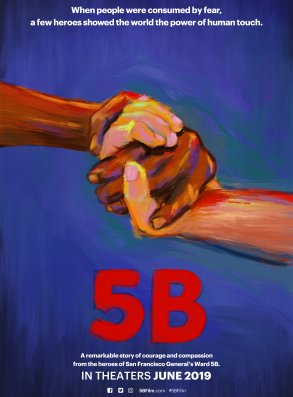
Verizon Media announced on April 30of this year that it would acquire the Johnson & Johnson funded film “5B”, and besides a theatrical release, would leverage its media prowess to promote viewership. “In addition to the theatrical release, Verizon Media will also amplify 5B across its ecosystem of nearly one billion global consumers and will create additional immersive content experiences using technology to enhance the story, compassion and humanity showcased by the nurses and caregivers at the forefront of the film,” according to the press release.
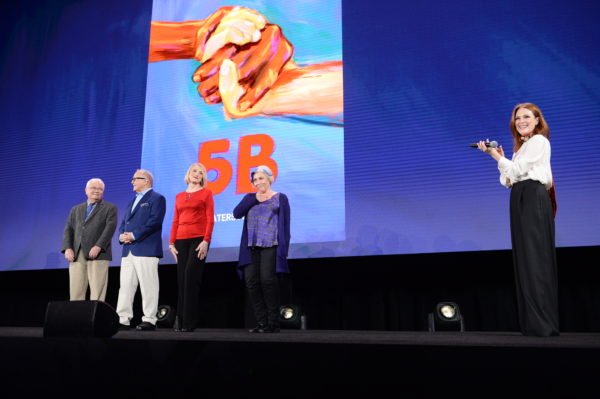
The success of 5B and the attention it has garnered over the past several months (Brand Storytelling was proud to screen the film on January 26 in Park City) has had to grab the attention of major brands that are considering investment in feature films or series and taking an equity position. If brands are moving money into content, why not make investments that can earn at least a portion of their money back in the sale of that asset while still earning the brand attachment to the story? Certainly, J&J will enjoy the brand association to 5B, an important story that sheds light on the essential role of nurses and the agony suffered by the gay community from the AIDS epidemic.
Brand Storytelling recently partnered with Participant Media and The Harris Poll in a survey of over 500 marketing executives to gain insights around brand-funded entertainment and specifically their interest in impact entertainment. The data is revealing! Most are planning to dial up investment in impact entertainment: 3 in 4 members of the C-Suite say they are comfortable investing time, money, and effort into impact entertainment (74%), and that the business case is strong for to invest in impact entertainment (74%). 86% of the C-Suite plan to increase or retain entertainment spend over the next 3 years, including nearly half (45%) who say they plan to spend more. The complete results of this survey will be presented atElevate on July 29along with the release of an accompanying White Paper that includes interviews with top brand marketing executives on this topic of brand-funded entertainment and impact issues.
Does this data portend the future for brands and their potential investment in impact issues and entertainment projects? Time will tell, but so far the evidence is pretty slim as there are very few films or series that are brand-funded. But, we can all imagine a media world where more advertising dollars are being re-directed to entertainment that is inspiring, educational and impactful. I’m staying tuned…
About Rick Parkhill
Rick Parkhill is a B2B media entrepreneur, founder of InfoText, Digitrends, iMedia and BrandStorytelling. A media junkie and observer, infatuated with the impact of media and technology on culture and society. Producer of over 100 advertising and media events, publisher, and journalist.
If you’re reading this, you’re a storyteller. An expert storyteller, really. We know you constantly want to deepen your practice, improve your craft and finesse your best practices. That’s where we come in. The Storytellers Brand Studio is here to help by leveraging the insights and skills of USA TODAY Network journalists and traditional oral storytellers to help organizations and individuals change the world. Before you go changing the world with your great story, let’s talk goals.
We understand that you need to persuade: You need a bigger budget. You want to crush this RFP. You need to close this deal. And we can help. We use templates and worksheets to make sure we’re telling the right stories to the right audiences at the right times. And you can, too. Great stories require great planning. So prior to making a deck, a proposal or a talking points document, consider starting a brainstorming and research document. Use the following to get you going:
You’re going to need a lot of facts:
Consider what goals and values you share with your audience and make a list. All stories are really about communicating values. So what values does your idea celebrate or support?
What is the problem you’re solving with your idea?
What are data points that support your idea? This could be market research. This could be case studies. Three or so should do it.
What are likely objections and pain points? Usually it’s budget, timeline, personnel resources. Can you develop responses to these that are rooted in your shared values?
Now start putting your story together:
Opening:
Acknowledge your audience and your happiness to be addressing them. Audience connection points go here.
State why you are there and what you will be talking about
Present overview of the idea, project, issue – this is the normal world BEFORE the investment or topic we are talking about started
Share the idea – as a solution/money/project
Middle:
Data that supports the idea
Establish meaning and contextualize your conclusions
Acknowledge pain points, then solve for them with an idea/tactic or suggestion for each
End:
Wrap up with an emphasis on recommendation based on data; remind them of the WHY we are doing this in the first place.
This is a primer outline for how to think through the research and the organization it takes to tell a truly compelling story. Of course, there are more details and nuance. The actual worksheet is six pages long, TBH. But we’re sharing this with you today to help you on your mission to connect more deeply with your audiences and change the world through storytelling. To learn what was in the whole six pages, or to just tell us your own story – reach out here: megan.finnerty@gannett.com
About the Author
Megan Finnerty is a journalist and storytelling consultant. Essentially, she’s a professional listener, who likes to talk. It’s complicated. She’s the director of the Storytellers Brand Studio, which curates and hosts live storytelling events for brands and nonprofits. And she’s the founder and director of the Storytellers Project, a nationwide series of live storytelling events from the USA TODAY Network. She’s coached thousands of people to share true, first-person stories. She graduated from Purdue University, and was a news features reporter at The Arizona Republic for 14 years. She feels strongly about feminism, cocktails, and NPR, and prefers a bold lip to a smoky eye.
Using data to determine audience is a no-brainer. But you’d better use a brain when implementing that data.
Take programmatic for example. It’s not difficult to understand why programmatic ad buys are popular. In theory, it’s a dream come true.
However, there are pitfalls to going all-in on a system that isn’t necessarily fully understood by those jumping to use it. Just look at what happened with last month’s brand safety crisis.
The inclination of the industry is to lay blame at the feet of Google and YouTube, But consider this – shouldn’t the brands and agencies that rushed to use what turns out to be a leaky system be culpable also?
In the race to compete for content creation and exposure, businesses have taken for granted that programmatic advertising requires finesse. It requires research, insight, and dedicated understanding.
Isn’t it worth examining the notion that although data is an extensive and valuable resource, ultimately it is best manipulated in the hands of those who are dedicated to it?
Enter companies like Zefr that are dedicated data institutions. They know a thing or two about audience selection because it’s what they do, and for that level of dedication you receive a window into understanding audience that far outpaces the algorithmic block buy offerings of DIY programmatic. For more on how Zefr is setting themselves apart from the competition all while ensuring brand safety, check out our Q&A with Andrew Serby, Director of Marketing at Zefr.
When you’re seeking a specific diagnosis and treatment for a unique health issue, does the buck stop at your general physician or do you see a specialist? The answer is simple – you go to the person who’s dedicated to solving your immediate problem. Why should it be any different when it comes to targeting your audience?
—
Watch for weekly news updates from Brand Storytelling in your inbox, and share this with other storytellers in your network.
Of course, if you’d like to contribute to the story, We’d love to hear from you. Email us!
I’m writing this on an airplane, flying back to California from an invigorating week of NewFront presentations, and visiting 1:1 with media execs at their offices. The shear amount of video content being touted by the forty NewFront presenters is stunning, but what I found most intriguing; is the promise by these media companies, to produce and distribute virtual reality content- all sorts of it; news, documentaries, live events and scripted shows that invite viewers to step right into the story. There is a ton– make that many tons of investment dollars directed at VR technologies, and now the content that will make it, well….real!
Sitting in the office of a biz-dev executive at a major media company last week, I looked around and saw several VR headsets. He picked one up, easily shoved his smartphone in it, thrust it towards me and declared, “This wave is real. The next nine months will see tremendous advancements in VR programming and acceptance.” I think I believe him.
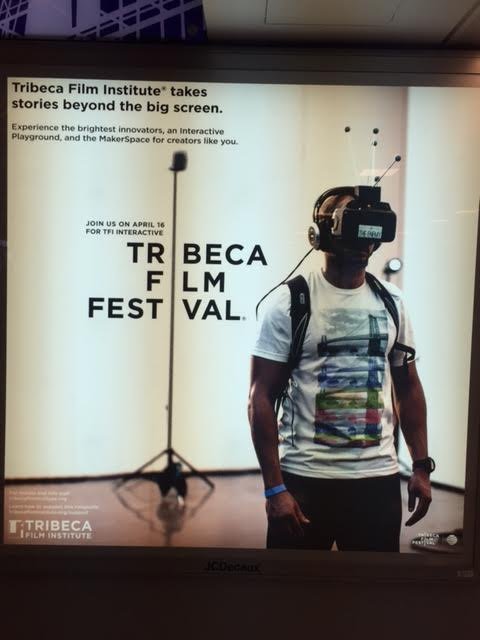
Walking to my gate at JFK this morning I stopped in front of this poster.
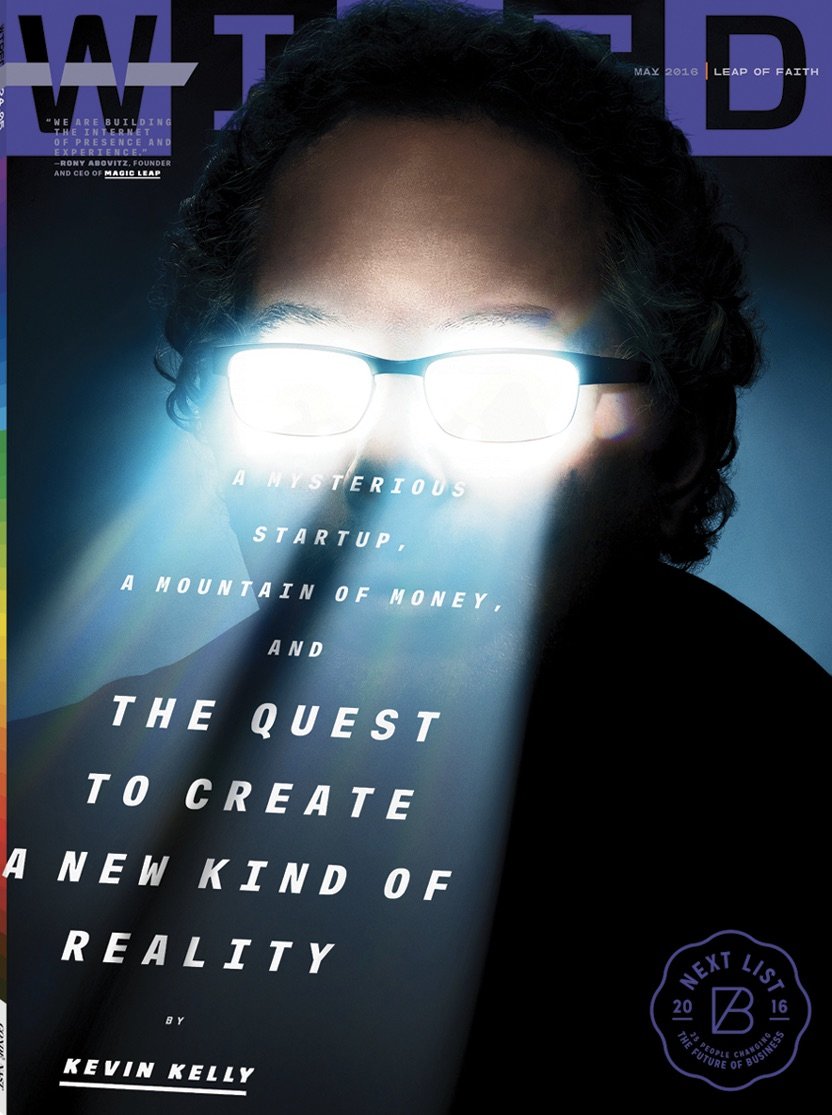
I stood there for awhile, pondering over the image and all that I had just heard as I beat around NYC. “This wave is real,” I kept thinking. I stopped and picked up the May issue of Wired and, of course, the cover article screamed out at me; “The Quest for a New Kind of Reality.” I devoured the piece by Kevin Kelly, the founding Executive Editor of Wired in 1992, and a guy that has been following VR technologies since 1989. If you aren’t sure about VR and the immersive future, I invite you to read Kevin’s article now before this rising wave crashes down upon you unexpectedly.
As I sit her now at 30,000 feet, I wonder, what’s next in the way of “Something-Fronts?” A VirtualFront? What might that look like? Heck, you wouldn’t even need to leave your home or office, just don the headset and be virtually transported to immersive presentations. No trans-continental travel. No in and out of Ubers and cabs, no standing in lines 8 blocks long hoping to get a seat where you might actually be able to see. It wouldn’t discourage people from attending in person, but it would surely expand the audience beyond New York City.
For brands and their agencies, there is a lot to figure out here. How will brands integrate messaging within a virtual experience? How will the industry keep awful ad practices out of the VR realm? Can you imagine what annoying ad units could fly at you in the middle of an immersive session? Would make popups and interstitials seem like reasonable advertising. I think the message is clear, this wave is for real and we all better get ready for a truly gnarly ride!
—
Not convinced the VR wave is real? Check out these articles:
In April of 2019, Vox Media acquired Epic, which includes Epic Magazine, the nonfiction storytelling powerhouse, and its sister company Epic Digital, the true story consultancy and content studio for leading brands.
Vox Media, the leading modern media company known for building media brands and the technology that enables them, grew this year in a merger with New York Media. It’s editorial networks now include Vox, The Verge, SB Nation, Eater, Polygon, Recode, Curbed, NY Mag, Vulture, The Cut, Intelligencer, Grub Street, and The Strategist. The diverse storytelling and advertising businesses within Vox Media include the Concert publisher-led marketplace, the Vox Creative content studio, the Chorus publishing platform, and the company’s entertainment division Vox Media Studios, which includes the Vox Media Podcast Network and now, Epic.
So how does a thriving media company with a broad audience and a bullpen full of advertising partners implement an elite squad of veteran journalists and non-fiction storytellers? By telling incredible brand-funded stories, of course!
We caught up with Zach Kazin (Director of Creative Strategy, Vox Creative at Vox Media) to learn more about how Epic functions to elevate projects within the Vox family and what it means to invest in bringing real, good stories to life:
Can you tell us a little more about Epic and why Vox Media sought the company out?
Channeling journalistic principles, Epic Magazine & Epic Digital were founded by Josh Davis and Josh Bearman – reporters with roots at Wired, This American Life, GQ, and Rolling Stone – in 2013 to publish extraordinary true stories. In addition to stories published in Epic Magazine (and commissioned for other publications), Epic was notable for Vox Media for two key reasons:
(1) The stories that Epic finds have become a pipeline for Hollywood (TV, Film, OTT) development; more than 40 of Epic’s articles have been optioned by Hollywood, including Argo, which won the Academy Award for Best Picture. This was a natural way to grow the Vox Media Studios division.
(2) Epic partners with brands to find true stories of real people that express that brand’s values. Notable projects include work with Google, Ford, GE, and IBM (see more here). For brands, Epic offers its unique Storyhunting service: Epic story hunters travel the world in search of true stories; we then present ideas for how each story could come to life; and finally we turn the stories into documentary films, magazines, books, video games, photo essays, live events, and speeches. This was an approach to storytelling for brands unlike any we’d seen on the market, one that we knew would further differentiate Vox Creative, our leading branded content studio.
Epic has lived within Vox Media for the better part of a year now – what have the applications of their expertise been within the Vox Media network?
On the Vox Media Studios side, we are building a pipeline of projects. Most notably, our Apple TV+ project, “Little America,” will debut its first season on Friday, January 17, 2020. Inspired by the stories first reported in the Epic Magazine series of the same name, “Little America” goes beyond the headlines to bring to life the funny, romantic, heartfelt, inspiring, and surprising stories of immigrants in America. The series has already been renewed for Season 2.
On the Vox Creative side, Epic Stories is now at the core of all non-fiction storytelling created by our content studio.. At a baseline, we’re able to pair the journalistic expertise of Epic with Vox Creative’s industry leading in-house strategy, production and creative direction. Stepping further, we now offer Storyhunting as a standalone service to Vox Media’s many brand partners (which can be executed and commissioned in a variety of ways).
How does a Storyhunt with Vox Creative work? Are there any examples you can share?
Epic’s Storyhunting is based on finding the right stories. Most projects that Epic produced prior the Vox Media acquisition were delivered to brands as assets or stories for clients to use. Vox Creative, by contrast, generally creates content tied to distribution plans, and typically, using the authoritative voices of our 13 editorial networks.
The combination – when employing a full story hunt – is a new way of tying this all together for brands. The process itself is simple: we start with a brief, followed by a few weeks of storyhunting in the field, followed by “storytime” sessions where we review the stories with the client. From there we determine where the story best lives, on its own merit and based on the marketing KPI we’re trying to meet, and execute accordingly by creating the desired content deliverables and distribution plan (or, in some use cases, the storyhunt itself is the deliverable).
Currently, Vox Creative, Epic, Digitas and KitchenAid are working together on a project that employed Storyhunting services, which will become a 3 part digital video series and a ~22-30 minute doc, and will release through a digital distribution campaign across the Vox Media ecosystem.
Often times brands can see the intrinsic value of investing in telling a story, but that doesn’t always translate to fiscal value. What do you do to account for that?
As more brands are interested in longer formats and more in depth storytelling – be that docs, series, or otherwise – they still typically are tied to marketing initiatives. Campaign KPIs pegged to a campaign timeline (or fiscal year) don’t exactly follow the same model as Hollywood development and distribution (which can take years). So taking the plunge into these more ambitious projects can be a hard sell up the chain for a brand leader and their media and content agency counterparts.
The benefit of the Vox Creative + Epic model is that we can do both: build a content program complete with campaign deliverables and KPI driven distribution goals within a certain flight AND develop the basis for in depth storytelling projects.
How can brands get involved?
To talk Vox Creative + Epic, Zach Kazin, Vox Creative’s Director of Creative Strategy, will be at Brand Storytelling. You can reach him at zach.kazin@voxmedia.com.
About Zach Kazin
Zach Kazin is the Director of Creative Strategy for Vox Creative, Vox Media’s content and creative partnerships division that connects brands to audiences through content and storytelling. The group leverages the editorial voice and insights of Vox Media’s diverse networks: Vox, Eater, SB Nation, The Verge, Polygon, Recode, and Curbed, NY Magazine, Vulture, The Cut, Intelligencer, Grub Street, and The Strategist.Since starting in 2018, Kazin has led the strategy for a number of Vox Creative’s most multifaceted partnerships, including it’s first major documentary project utilizing the 2019 acquired Epic Digital’s Storyhunting services.Zach previously was the Global Director of Digital Platform Partnerships at Red Bull Media House, overseeing the brand’s media relationships and content strategy with platforms including YouTube, Facebook, Twitch, and TikTok, growing the brand and its sponsored athletes and talent impact on communities worldwide. Through growing programs like the once-grassroots (and now MASSIVE) Spanish language freestyle rap competition Batalla de los Gallos, to turning an athlete into an influencer via YouTube strategy (ie. Jason Paul), to disrupting Twitch with athlete-hosted live streams of anything from Mountain Biking to Red Bull Flugtag, Zach continually led innovation designed to super-serve communities and drive audience engagement.Prior to Red Bull, Zach spent two years at Aol leading video distribution partnerships, ran a small production company (Illium Pictures), and started his career at Lionsgate Entertainment, building TV network brands (most notably, an effort to transform streetwear retailer Karmaloop into a multi-platform media company, Karmaloop TV).