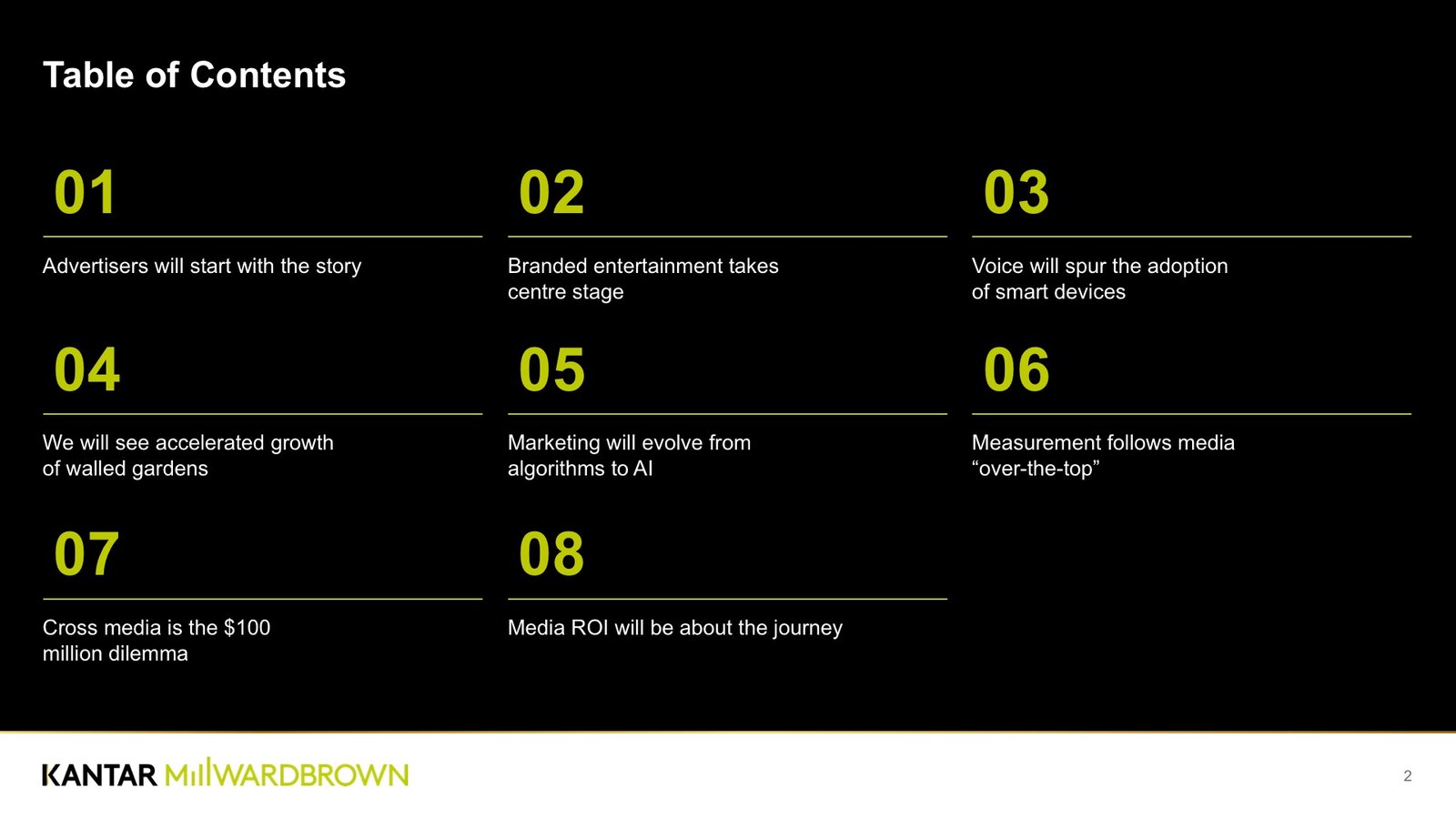
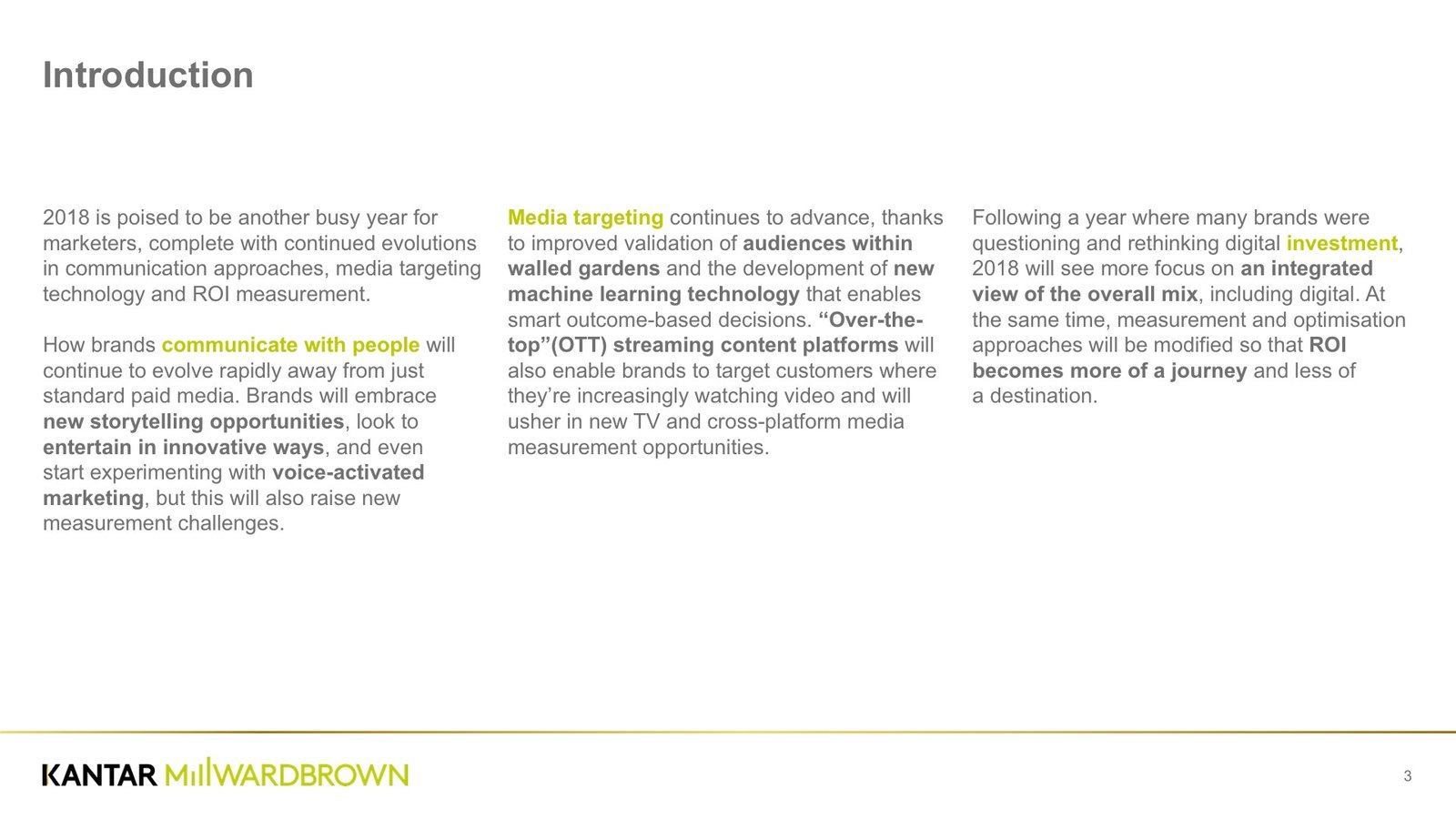
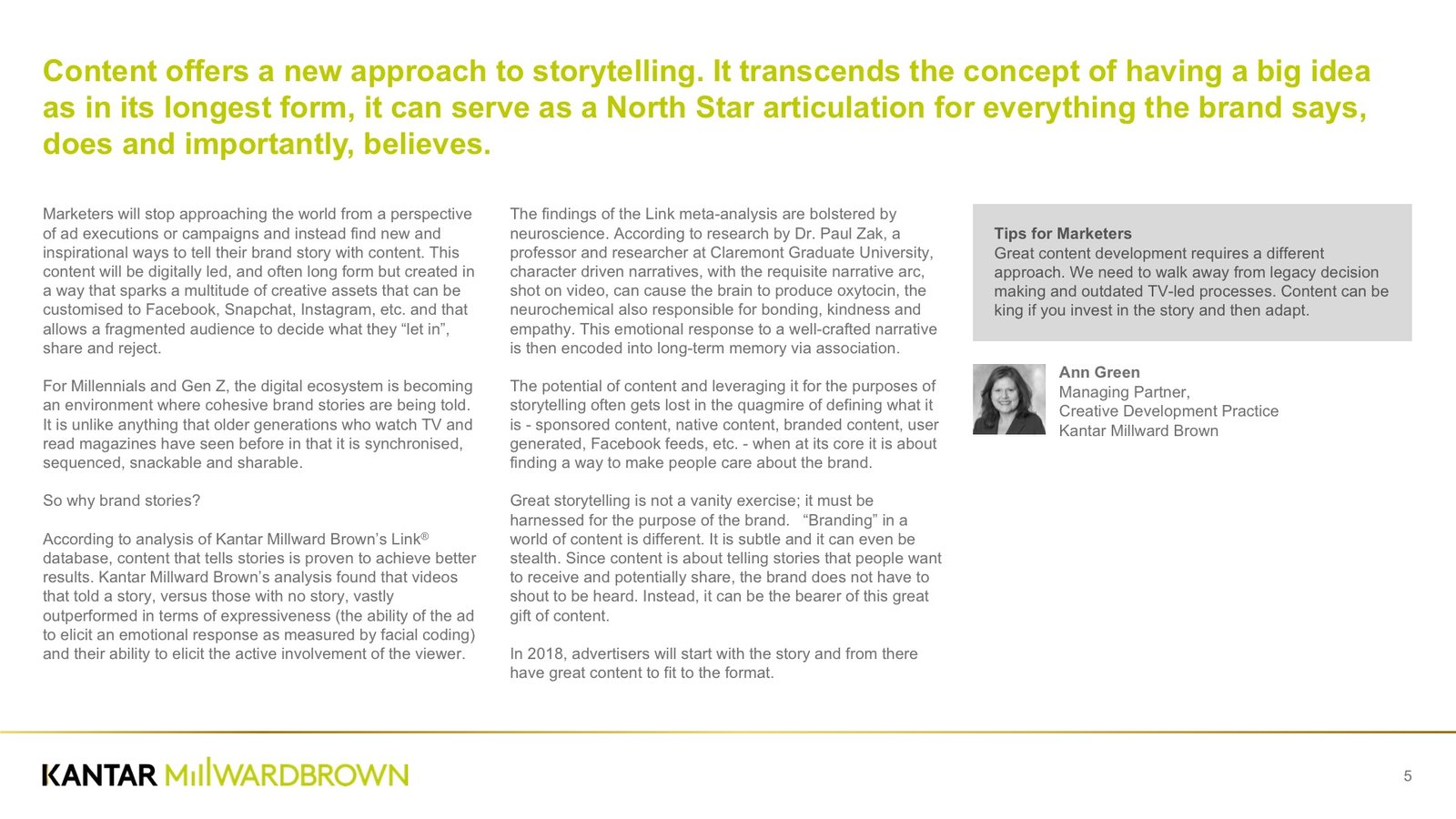
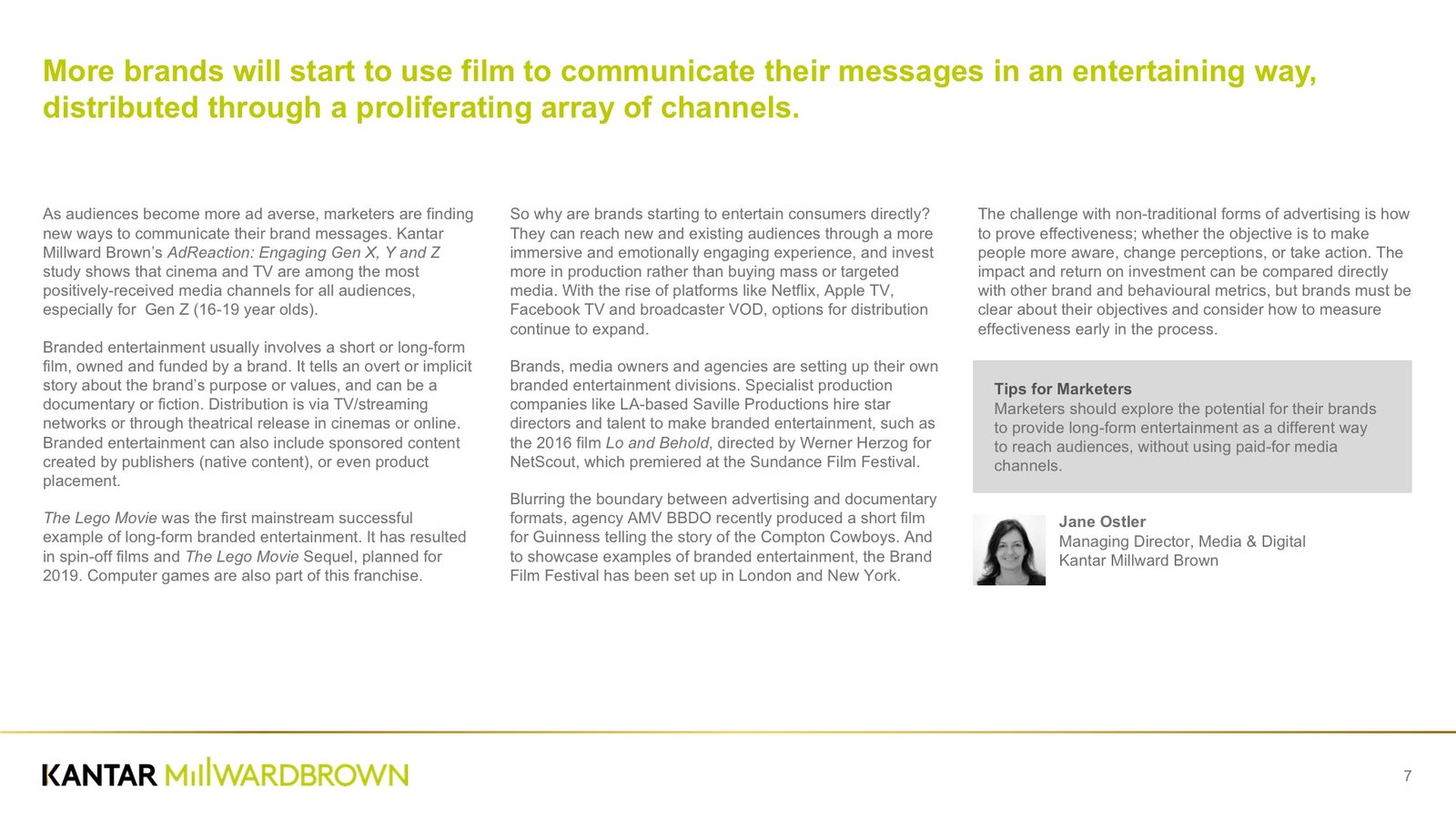
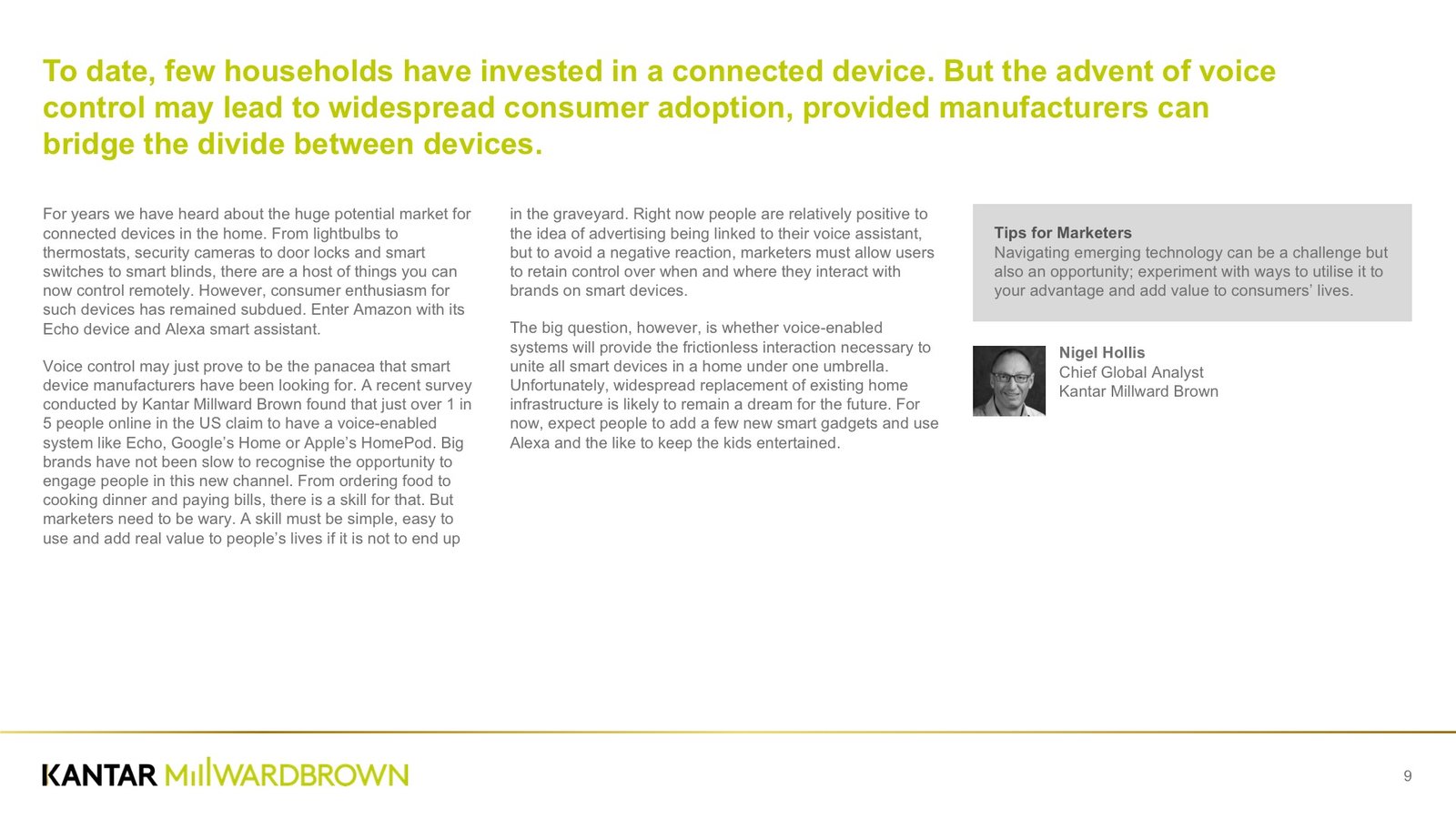
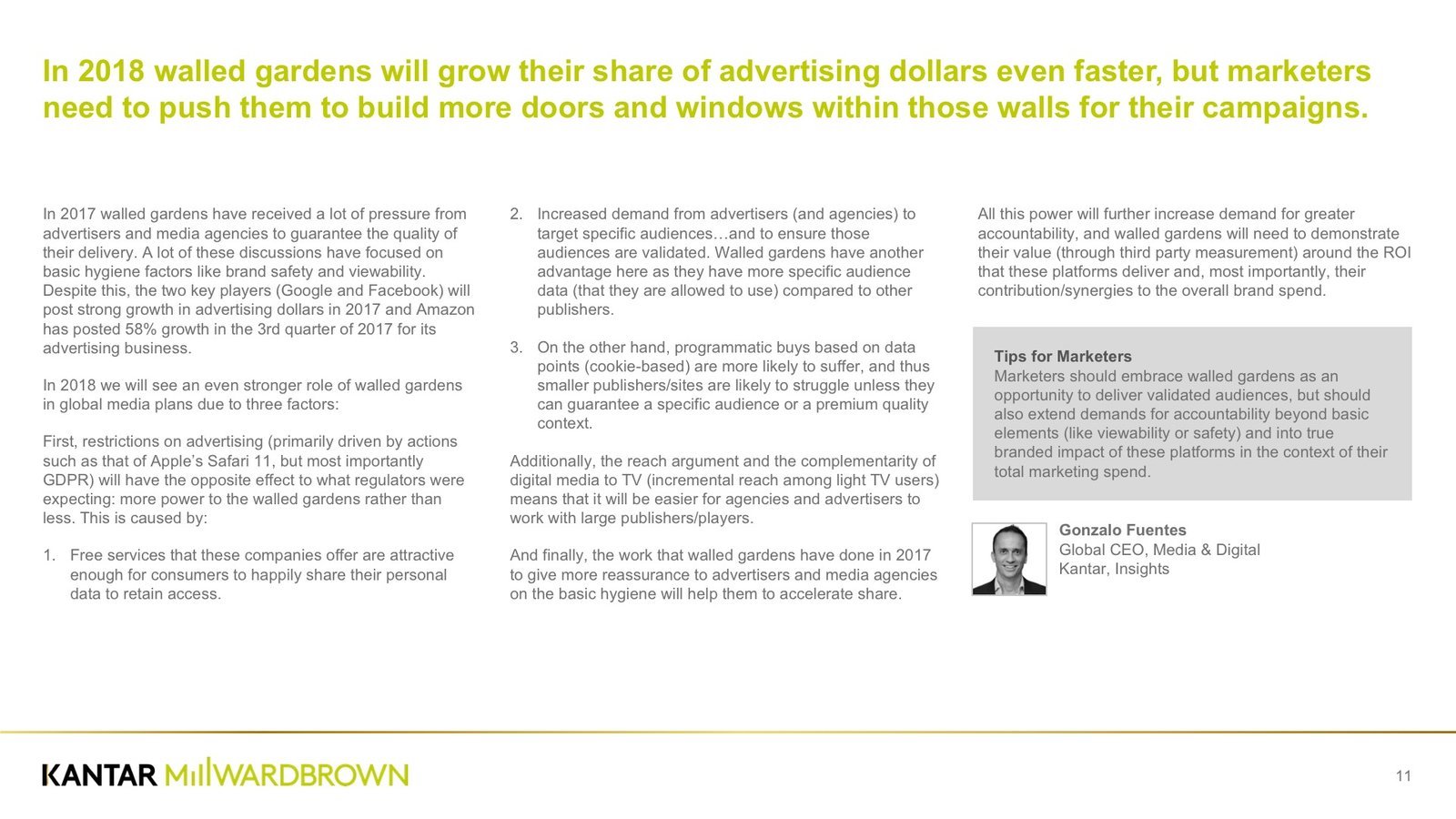
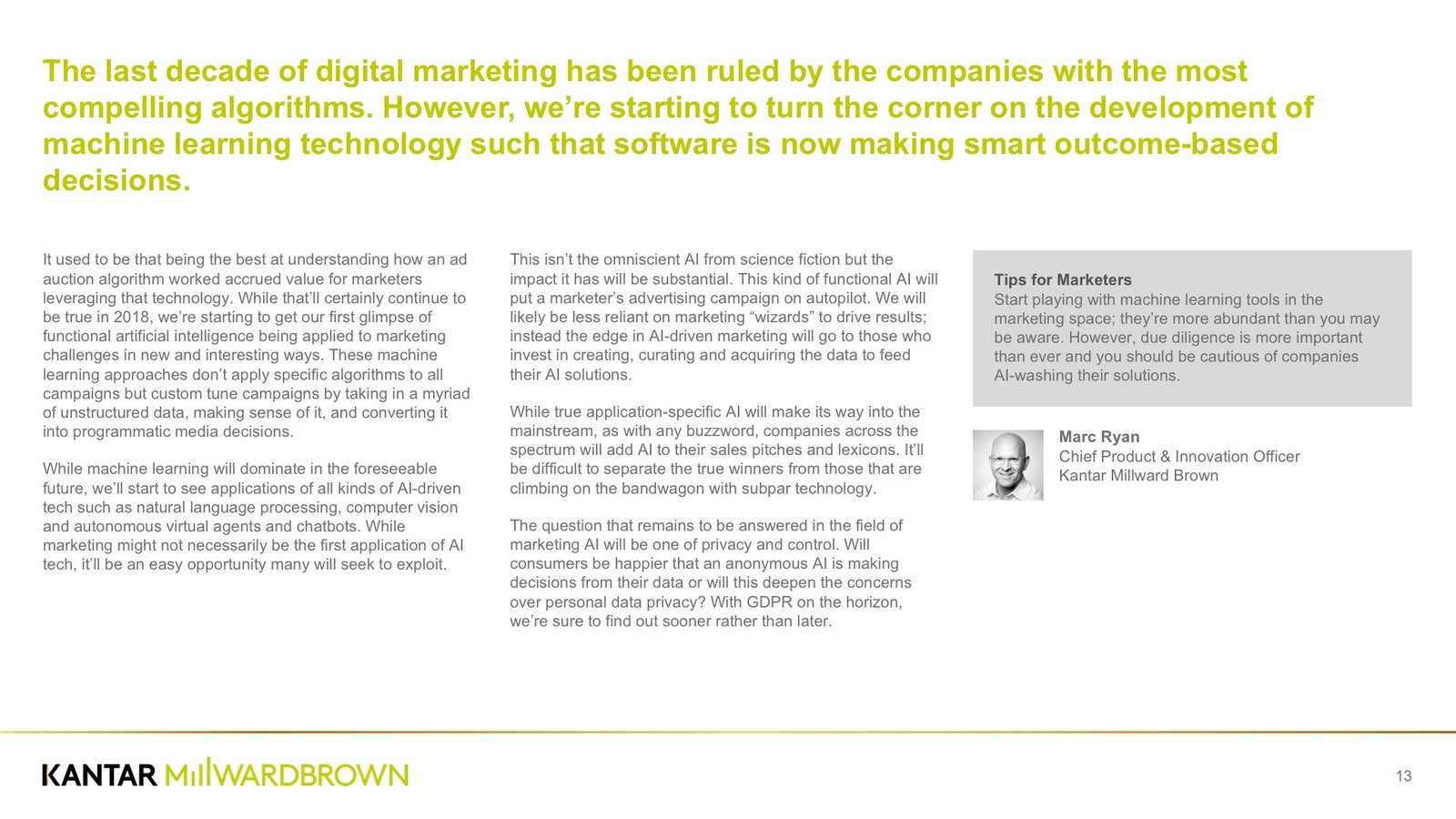
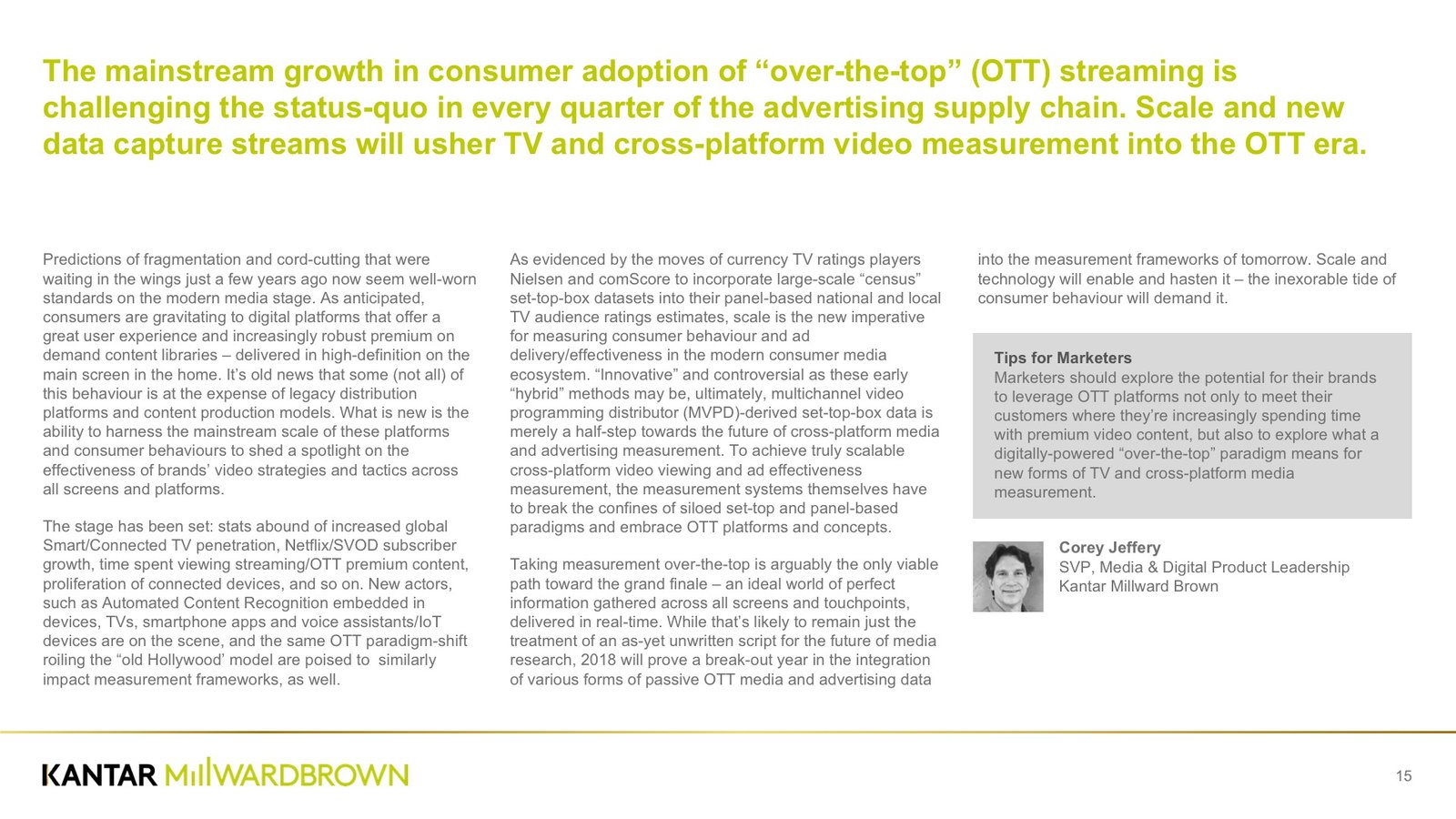
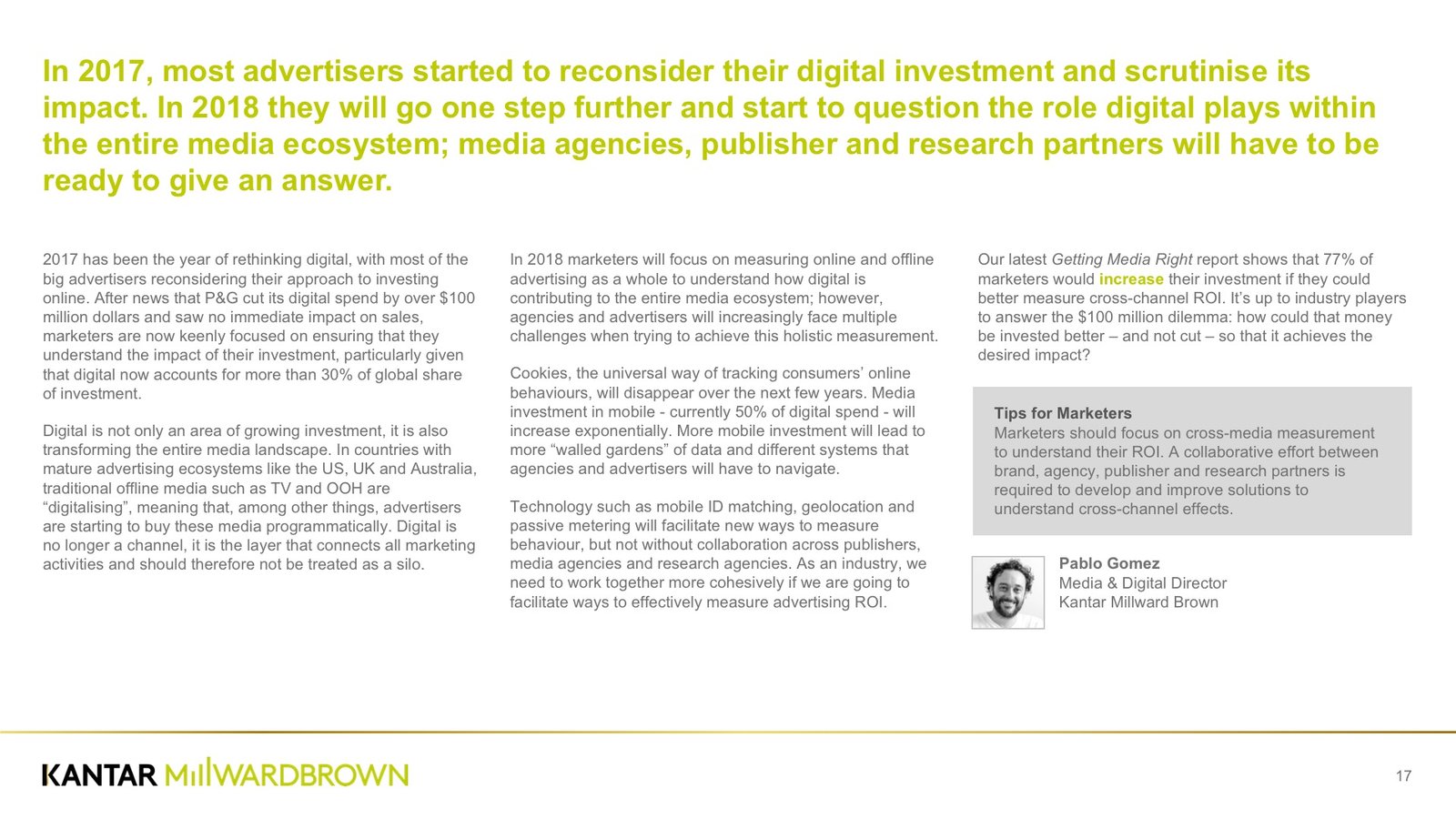
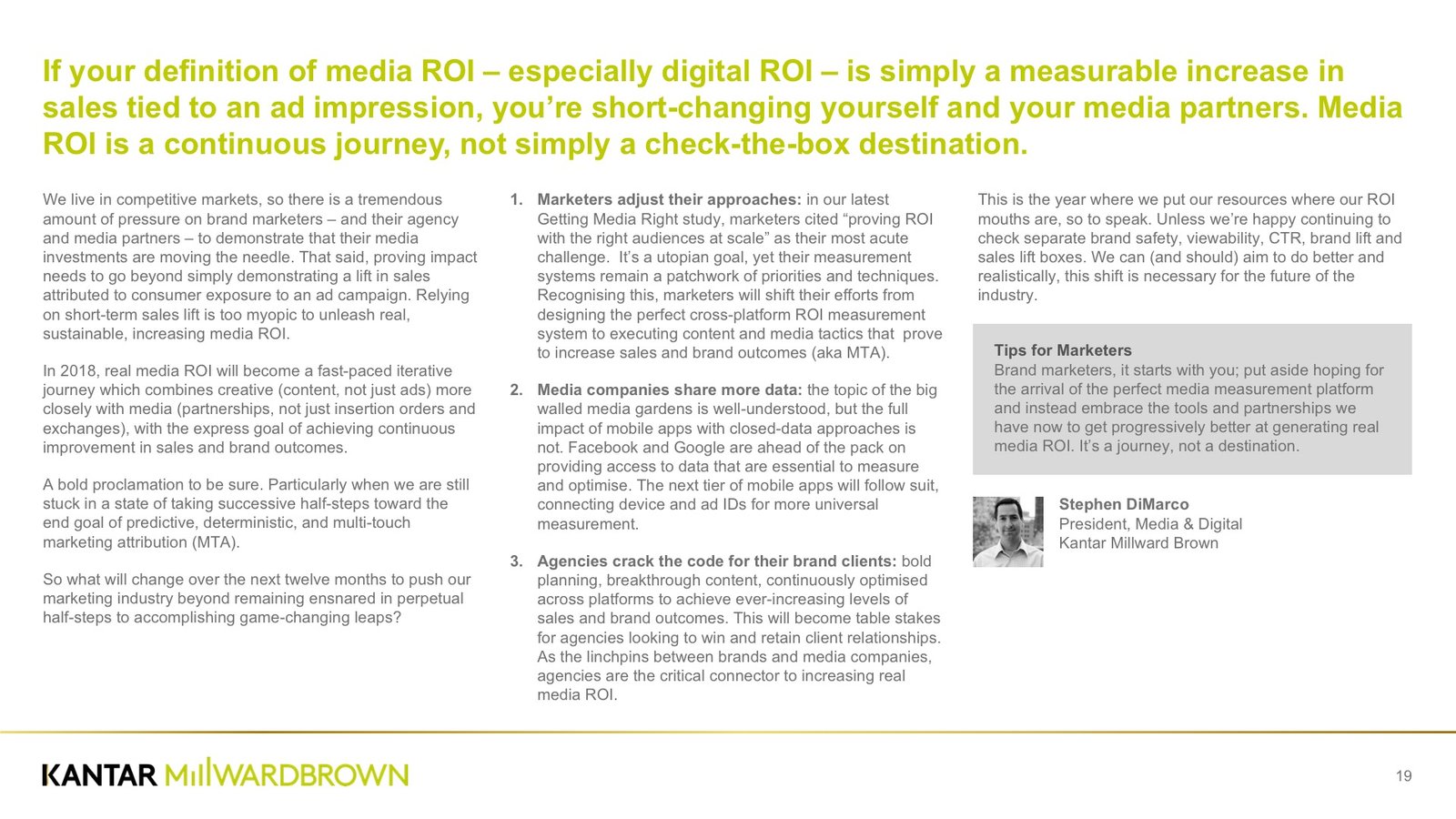
Kantar Millward Brown, global industry leaders in defining brand purpose, developing winning advertising, engaging consumers, and driving brand growth, recently published their 2018 media and digital predictions report. In it they forecast everything from a shift from marketing algorithms to AI to increased consumer investment in voice-controlled connected devices. But of the eight large predictions the report makes, it’s Kantar’s first two that we find most intriguing.
One: Content offers a new approach to storytelling. According to analysis of Kantar Millward Brown’s Link® database, content that tells stories is proven to achieve better results. The prediction is that next year, advertisers will start with the story and from there create great content to fit to the format.
Two: More brands will start to use film to communicate their messages. In this way, brands can reach new and existing audiences through a more immersive and emotionally engaging experience. The report even gives mention to friend of Brand Storytelling Saville Productions, whose 2016 film Lo and Behold (directed by Werner Herzog for NetScout) premiered at last year’s Sundance Film Festival.
The Kantar Millward Brown Media and Digital Predictions report is full of relevant insights and interesting predictions for the new year. For more details on their marketing, storytelling, and ROI predictions click through the full report below (click slides to enlarge).
—
Watch for weekly news updates from Brand Storytelling in your inbox, and share this with other storytellers in your network.
Of course, if you’d like to contribute to the story, We’d love to hear from you. Email us!
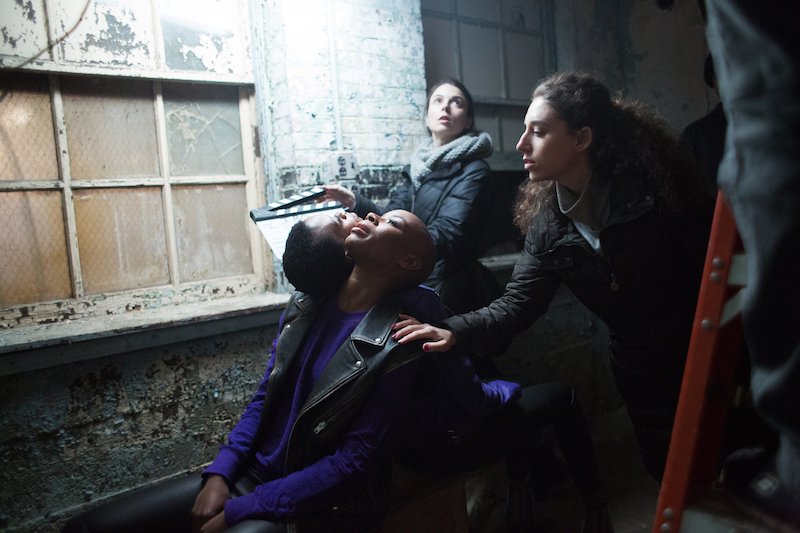
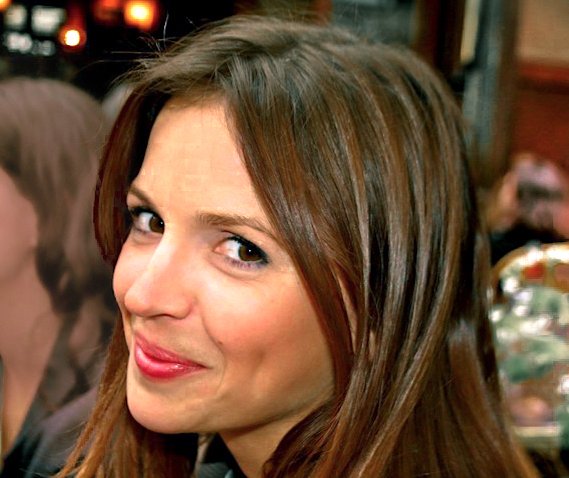
Stephanie Bollag is a woman with a vision. Bollag, a Swiss film student at the Tisch Graduate School, is a storyteller and fashion filmmaker whose work is both dark and tender, provocative and sensitive. In her last semester at NYU, after directing several narrative shorts, she discovered her niche: visually and viscerally evocative stories at the intersection of fashion and film told through the female gaze.
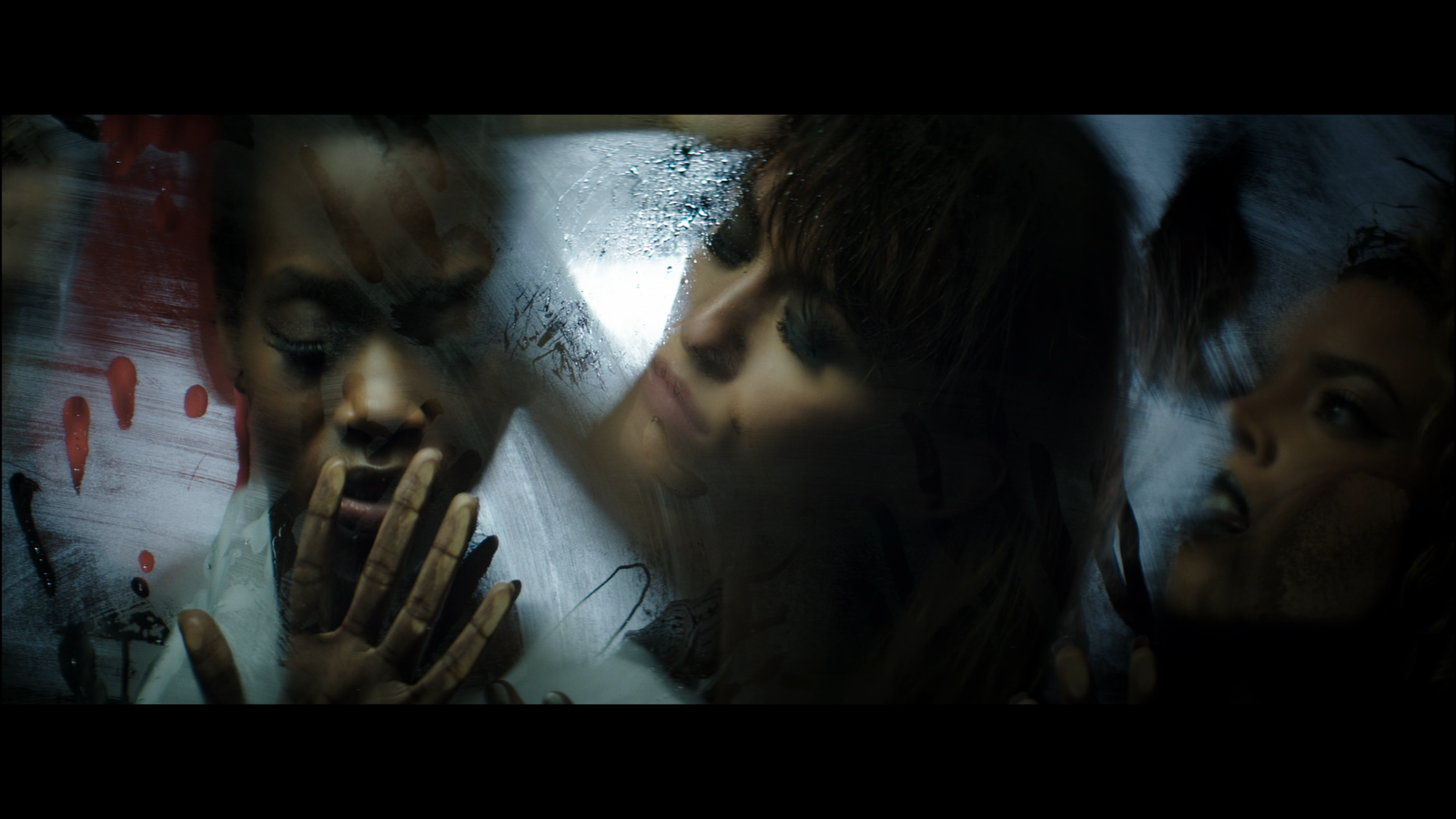
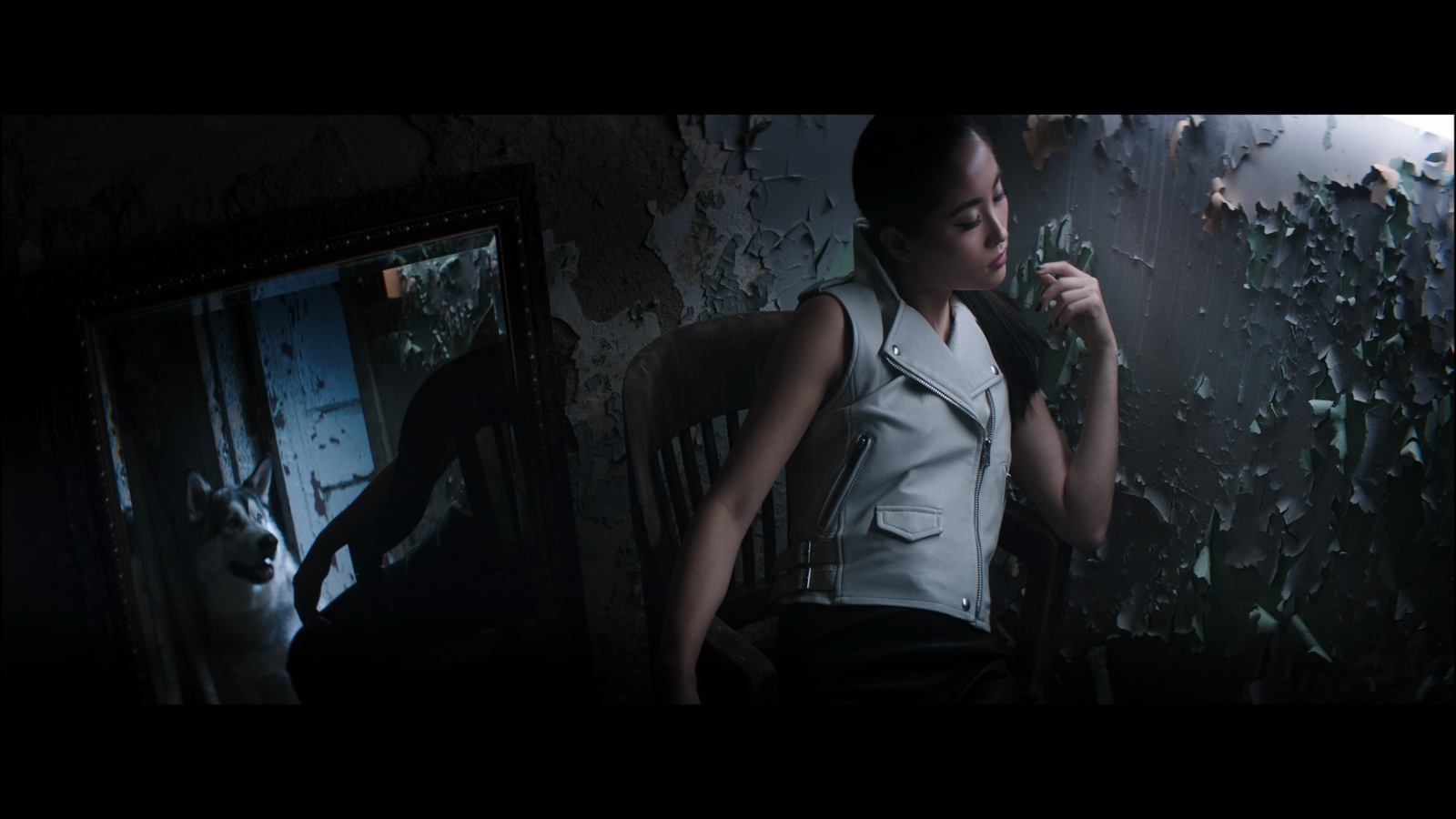
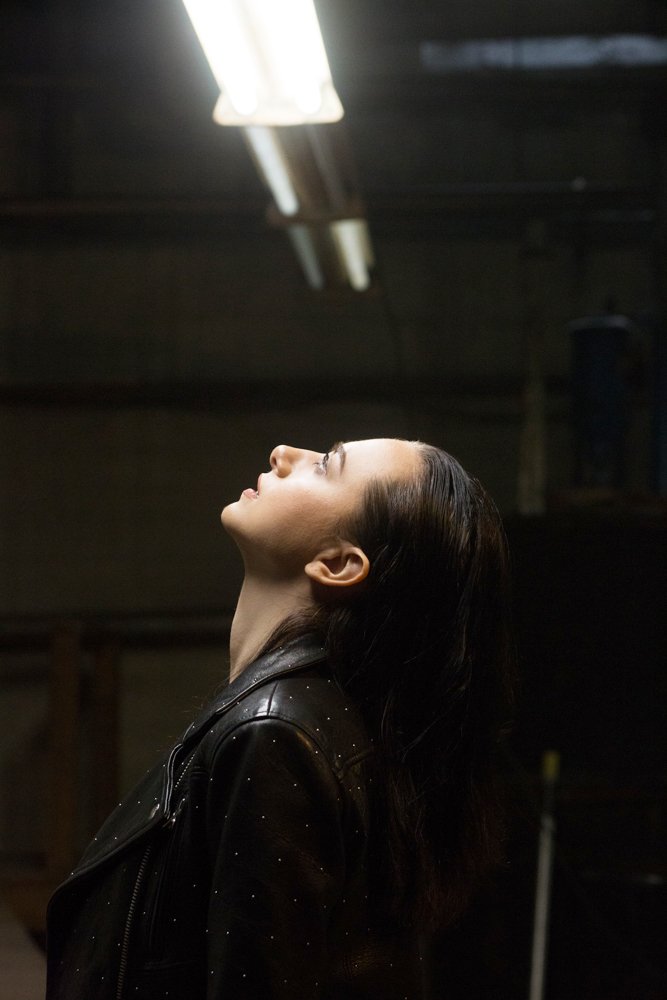
Her fashion film A Tale of Endurance: Celebration of the Imperfect, which she wrote, directed, produced and edited on spec for the French fashion brand IRO Paris is a celebration of color, race and women. It is meant to send an empowering and disruptive message about pre existing gender norms and racial stereotypes.
Brand Storytelling connected with Bollag to discuss her draw as a creative to making branded films, the value of having brands partner with creatives, and the importance of connecting with brands to tell authentic stories.
You call yourself a “fashion filmmaker.” What does that mean to you? How did that come to be your niche?
First and foremost, I am a filmmaker and storyteller. That said I feel at home with fashion. I grew up embedded in the business. My father was one of the people to make ESPRIT big in the 80s. The funny thing is that I always rejected the idea of following in his footsteps. Cinema is what fascinated me, and I could not envision a career in fashion.
Over the past two decades and especially during my graduate film studies at NYU Tisch, I refined and defined my aesthetic and sensibility. It also became evident that my ideas generally were too grand and too dreamy for the naturalist, indie filmmaking approach film school teaches. Which is how I discovered my niche; visually and viscerally evocative stories at the intersection of film and fashion told through the female gaze.
To me being a fashion filmmaker means that I can express stories and emotions visually without the expectation of a coherent storyline. Fashion films allow me to follow my gut and engage audiences through visuals. A strong, beautiful or disturbing photograph or painting can evoke all sorts of reactions. You can feel pain or pleasure by merely looking at an image. It is that visceral quality I strive to achieve in my work. As a classically trained painter turned filmmaker I found that fashion films allow me to do so.
How did you settle on this project? At what point did you connect with IRO to work on this project?
I wanted to create something edgy, dark and powerful. Early on the French fashion label IRO came to mind. A few years back I was introduced to the founders/designers of IRO, while doing the fashion buying for the IRO store in Zurich. I since followed the brand’s progress and kept in touch with the designers. I had just barely conceptualized the idea and pitch for the film, when I reached out with a questionnaire about the philosophy and mission of their label. The designers were familiar with my previous work and open to the idea of a fashion film for IRO.
“A Tale of Endurance: Celebration of the Imperfect” is a weighty title for a fashion film in which all of the communication is done with physicality and the face. Where did the concept come from? Where did the brand stand on this concept? Why offer to do something like this on spec? What do you seek to gain in creating work like this for yourself?
All my narrative films to date are centered on female characters trapped or confined by some inner or outer force, which they try to break free from. Life for them is “a tale of endurance” no matter the outcome. Enduring makes them stronger and more resilient. 18 months ago my father was diagnosed with terminal cancer. In situations of life and death everything becomes heightened and so did my artistic vision. I had all these emotions I could not put into words. This influenced my decision to make a film in which the images, sounds and music (not words) would carry the story.
Another source of inspiration for the concept was the interchangeability of IRO’s clothes between the sexes, which sparked the film’s central themes of androgyny and sexual identity. Fitting the models and actors at the IRO showroom in NYC, my stylist frequently assigned an article from the men’s collection to a female model/actor and vice versa.
Like most artists I felt an outsider growing up in Switzerland. Living in New York I feel at home. The norm does not interest me. A Tale of Endurance is thus also a tribute to the hodgepodge that is New York. Diversity yields emotional and visual texture. The models and actors I cast are of every color, ethnicity, gender, shape and size. The film’s superhero is a woman disrupting the status quo. As a result the film is multilayered and hopefully prompts discussions that extend past the surface.
I offered to make this film on spec for IRO for a few reasons. To me IRO’s clothes implied an untold story. Their unconventional use of hard and soft materials is reminiscent of my own visual language and sensibility. I imagined the IRO woman as a heroine in one of my films. But most of all, I saw a missed opportunity for a strong brand to market its product. Going into it I knew there was a risk of IRO rejecting the film, but I had nothing to lose. “Worst case” I would end up with a fashion film that embodies my aesthetic and vision and could be used to present myself to future fashion brands and collaborators. Whereas IRO liked my original concept and mood boards, and gave us access to their Pre- and SS17 collections, they finally found the film too risky and arty. Ultimately the film was not commercial enough for them.
As a storyteller, how do you feel about brands’ increased interest in moving toward artful storytelling rather than simply continuing to produce traditional interruptive advertisements?
It means my livelihood, so I fully support the trend. But jokes aside, I definitely agree that we are slowly moving away from advertising in the traditional sense towards more narrative marketing campaigns. In a world in which information is overflowing, showing off a brand’s USP (Unique Selling Proposition) does no longer suffice. Rather than a rational explanation of why their product is better, cooler, etc., brands need to appeal to audiences’ subjective experiences. The intangible is what determines the success of that tangible thing they are trying to sell. And what better way to market a product or service than by telling a compelling story that attaches meaning and emotion to it. Brands are only just starting to understand the value that storytelling and filmmaking bring to the table.
To me the creation of fashion films and branded content is not merely about making something artsy that is cool looking. Real storytelling means connecting the audience to the brand’s core value system. Today’s audiences can’t be emotionally coerced into brand loyalty. They are smart and demand a continuous relationship that needs to be groomed. Brands need to understand that the storytelling approach to advertising is a long game and a lasting effort to produce meaningful and appealing content that showcases the brand favorably while remaining emotionally connected and relevant to its target audience. This can only be achieved over time. One film isn’t enough. But if used correctly the tool of storytelling will continue to give.
What advice would you give to up-and-coming creatives looking to foster great working relationships with brands?
It is a fine balance between keeping up to date with what is happening in the ever-changing marketplace and fostering your aesthetic and stories on your own terms. It is a constant juggle between listening to others and following your gut. Having a strong portfolio, website and/or a film that represents your sense of story and style to a potential client is key. I would advise any aspiring creative to experiment a bunch before putting their professional reputation on the line. The rules of ‘fake it till you make it’ don’t quite apply to filmmaking. There is a lot of knowledge, life experience and technical skills involved in the creation of a film. I am not saying film school is a must, but it definitely gave me the liberty to experiment and ultimately find my niche. Nothing beats having a deep understanding of the craft and developing your own voice through trial and error. Of course that requires resilience and patience. In terms of pitching to clients, I would always advise to meet with them face to face. So much of what I do is based on personal interaction and chemistry. Treat them as your collaborators.
Joe Marchese made his Upfront debut yesterday at the Fox upfront presentation, having just been named the new ad-sales leader for the massive Fox Networks Group just days before. “It’s a heckuva third day on the job,” he told the packed house of media buyers and advertisers.
Imagine the pressure he might feel as he squares off against a league of video content all-stars spanning digital, cable and network broadcasters. Never has the competition been so fierce for video ad dollars and, perhaps, never has the future loomed so uncertain. And, then, along comes Joe…
Marchese joined Fox Networks Group (FNG) back in December 2014 when he sold the company his digital ad business, TrueX, for reportedly $200 million. The choice to put Marchese in a leadership role with FNG underscores the dramatic shifts in audience attention and media consumption. Traditional interruptive advertising must change and FNG is making a bold statement that they recognize that fact and are betting on a guy who will lead that change for them.
Quoting from a May 10, 2017 Variety article: “This is the start of the hard work,” said Marchese in an interview, indicating that he was eager to come up with new ideas for advertisers at a time when technology has made the act of avoiding or ignoring traditional TV commercials much easier. “We are going to see a new model” of advertising put into place around video content, he said.
This year during Brand Storytelling at Sundance Film Festival, Marchese captured the attention of the brand and agency audience with his thesis that “The Market for the World’s Most Valuable Resource is Broken,” and that resource is attention. This is a fascinating presentation that really simplifies the challenges advertisers and their media partners face today when we don’t value people’s time correctly. Invest 15 minutes of your time to watch this today and tell me if it doesn’t make the media world a little clearer. It’s very insightful thinking from a guy whose big job just got a whole lot bigger.
—
Watch for weekly news updates from Brand Storytelling in your inbox, and share this with other storytellers in your network.
Of course, if you’d like to contribute to the story, We’d love to hear from you. Email us!
Zefr, the video advertising and digital rights management platform, sets itself apart by taking a unique approach to data-driven audience selection. We chatted with Andrew Serby, Director of Marketing at Zefr, about “Mindset Marketing”, brand safety, and the importance of reaching the right audience at the right moment.
—
At Zefr, you practice the art/science of Mindset Marketing. What is that?
Basically, the concept of Mindset Marketing came from applying the relevance of search – being useful for consumers when they are actively seeking out information – to the power of video. Combining the two, and reaching consumers with video ads at the precise moment they’re most interested in hearing from your brand, is something we’re focused on.
What is the importance of finding the right audience at the right moment? Why should brands/advertisers care?
It’s a marketing cliche, but it’s true. When you reach people with relevant ads, at relevant moments, advertising just works better. We measured the impact of aligning contextually relevant ads on YouTube content vs. traditional keyword/channel targeting with the IPG media lab and found it drove a 63% lift in purchase intent, 83% lift in recommendation intent, and a 40% lift in overall favorability. It makes sense – consumers are seeing that an ad experience that’s relevant to their interest is important and enjoyable.
What is the difference between working with a company like yours to pinpoint audience and the DIY Programmatic direct ad buy?
There are significant hurdles with audience targeting on YouTube, as shared devices continue to proliferate around households, and so many users are not logged in. Let’s say a child picks up his dad’s iPad – if you’re an auto brand using audience targeting, your ad is reaching the kid, not your dad – it’s irrelevant, and you’ve missed your audience entirely. That’s we be built technology focused on understanding the context of the content being viewed, and use that technology to help target individual videos – not just audience, keyword, or channel. It’s a much more powerful approach to video advertising.
Brand safety is a highly discussed issue of late. What’s your take on that?
It’s important that brands know where their ads are being placed, and the brand safety news speaks to larger challenges. The ad community has developed such sophisticated ways to find an audience, that the content they’re aligning with sometimes takes a back seat. The brand safety issues were an outcome of that – and brands that are focused on aligning with premium content are reaping benefits.
What does a company like yours do to ensure brand safety?
It’s really important that every brand message is in front of content that makes sense for their brand. That’s why we whitelist – not blacklist – videos that a brand would want to target. It’s not just about brand safety, but brand safety is an important criteria. At Zefr, we make sure every video is relevant to a brand’s objective, it’s brand safe, it’s forecasting views (at least 10,000) and that it can perform against KPIs. If any of those criteria aren’t met – we would never run a brand’s message against the video.
What sort of conversations need to be happening between brands/agency partners seeking data solutions and companies like Zefr?
We see a ton of success with the strategy teams that are looking for insights into what type of content their audiences are watching on YouTube, and those insights are brought to the Activation teams to actually carry out the buys. We’re helping brands actually segment their content strategy, and then activate against that exact strategy, and use the results to inform the next campaign. It’s a virtuous cycle that’s empowered by technology, that’s really just enabling brands to be smarter and more effective than they have before.
—
Watch for weekly news updates from Brand Storytelling in your inbox, and share this with other storytellers in your network.
Of course, if you’d like to contribute to the story, We’d love to hear from you. Email us!
“We use our own social media platforms and channels like one giant creative incubator: a place to experiment with everything from new talent to new formats to new platforms. This learning deeply informs our development and helps us stay ahead of the ever-shifting media landscape”
Check our latest Spotlight, featuring the team at Astronauts Wanted!
Gabe Gordon, co-founder and managing partner of Reach Agency, has 15 years of global experience in content marketing building creative, integrated solutions for world-class brands such as General Motors, The NFL, Nestle, Walmart and PepsiCo. Of late, Reach is further cementing itself as a leading name in social and new media, having recently been named the lead agency for Nestle’s Butterfinger and Crunch candies, as well as adding new power players to their team. Brand Storytelling caught up with Gordon to talk about the agency’s agility, the key to developing integrated marketing for the social generation, and why he keeps coming back to Brand Storytelling at Sundance.
—
It was recently announced that you are working with Nestle Crunch and Butterfinger. In a recent article, one of the key differences cited about Reach was that the agency is “agile and collaborative” – what does that mean to you and to the agency?
Reach was founded 6 years ago as a YouTube Agency. None of us had worked at another agency before, so we created an agency operating model that we thought would work best in this new media environment. The traditional agency model we saw in other agencies had layers of complexity and process that were unnecessary for social. While we adopted some elements of the legacy agency model with growth, overall our agency model has fundamental differences, not only in how we operate, but how we engage with clients. Because of this we can be more agile, collaborative and efficient than many other agencies.
Reach lives to engage brands with a social generation. What would you say is the most important thing you do as an agency to make engaging brands with a social generation possible?
As an agency, the most important thing we can do to help our clients engage with new generations is gain their trust. Social generations from Millennials to GenZ are constantly evolving, which means as an agency we have to help our clients constantly evolve communications strategy, creative and tactics to engage with those consumers. The reality is that to do this well, you can’t always wait for someone else to generate a best practice, you have to build a system to develop proven, scalable tactics quickly and with a responsible investment. To do that you need to earn the trust of your client to empower you to take the right risks, fail and learn.
While this may be your first year as an advisor to Brand Storytelling at Sundance, it will be your third year attending. why do you keep coming back? What do you get out of it?
I go to a lot of conferences and there isn’t anywhere else you can really engage with top level brands, publishers and agencies in such an intimate setting. For me this event is about relationship building with industry leaders learning through conversation, not presentation.
Why do you think it’s important for advertisers to be in the proximity of the Sundance film festival and participate in a sanctioned Sundance event like Brand Storytelling?
The mission of the Sundance Film Festival is to advance the work of independent storytellers in film. For over 30 years it has been the forum for independent filmmakers to showcase their work and make a name for themselves. As brands are entering into the world of storytelling and changing how we engage with consumers, there couldn’t be a better place to advance the business of brand storytelling and showcase our work.
What are you hoping to see from our incredible presenters at this year’s event?
Great stories of course! I am looking forward to hearing how media is evolving the influencer landscape, how brands and publishers are winning with new content distribution models and getting an inside look at the recent brand success stories.
You can hear more from Gabe Gordon and the rest of our advisory board in January during Brand Storytelling at Sundance Film Festival 2018. Please visit our website for more information on how you can attend this one-of-a-kind event.
—
Watch for weekly news updates from Brand Storytelling in your inbox by subscribing, and share this with other storytellers in your network.
Of course, if you’d like to contribute to the story, We’d love to hear from you. Email us!
Discussions revolving around the implementation of data in the content marketing pipeline have changed over the course of a calendar year. In as much time as it’s taken to get decision makers on board with consumer analysis, the word data has become synonymous with measurement, relegating it to the last item listed on a post-production to-do list. Enter companies like ICX Media who are out to upend that definition by demonstrating the value of integrating data early in the creative process, achieving a balance between creativity and data science that uplifts all. Brand Storytelling met with ICX Media’s Vice President of Strategic Partnerships Brian Zuercher to discuss the art/science balance and how ICX helps achieve that balance for creators and marketers alike.
How did ICX Media get its start? What was the impetus for opening up shop?
At the heart of ICX Media is a curiosity about the future convergence of art and science. Our founder, Mike Avon has been operating at the intersection of data and marketing for years.Mike helped launch Millennial Media as a venture capitalist and later joined the company to lead its successful growth phase and IPO (NYSE: MM).
ICX Media is a response to the ‘democratization of content’– a phenomenon born from the prevalence of mobile technology and ability for everyone to self-broadcast on social platforms. With this revolution of the media industry comes the new emergence of a “creative class.” ICX Media allows both creators and marketers access to better data about audiences, to inform their future creative endeavors, which in turn provides better video for content consumers.
Tell us about the growth ICX has seen over the last year and how that’s changed the company’s capabilities.
For the first 18-24 months, the ICX Media team focused on building out the core technology to withstand massive data and computational needs associated with processing video and video data at scale. For the last 7 months, ICX Media has been focused on going to market. We’ve grown to 40 employees including installing our presence in NYC and LA. In May we acquired SEEN, a Columbus, OH-based creator tech and service company that had been working with big brand clients bringing to life creator storytelling through influencer marketing campaigns and media properties.With this high-caliber team and established tech foundation in place, we are now moving beyond project-based work to begin onboarding our first major enterprise clients in media, entertainment, and brand marketing. Fun times!
The AI core is central to ICX enabling data and creative harmony – how does it work?
The AI engine at ICX Media is constantly learning and generating insights by looking at and analyzing videos and audience engagements to those videos. For media companies, creators, studios and other storytellers, ICX Media brings that audience understanding to bear in order to help narrow in on what drives audience engagement. For example, is there white space that is being ignored? And which creators (both topically and individuals) are hitting that audience? We use the line “create with confidence,” by which we mean increasing creative capacity with a specific purpose. Audiences win because they get to consume better content and creators win because they please audiences and find continual growth.
What is the greatest obstacle you face when working with brands in this space?
We are sympathetic to brand marketers and the incredible challenges they face. The digital landscape is changing at a breathtaking pace. Our biggest obstacle is helping brand marketers weave data into their strategies early enough in the creative process so it can help inform the downstream tactics and creative output. We want to show brands how data should be an integral part of the creative process– not just a measuring stick at the end. In the past data was primarily a hindsight tool, so shifting thinking to foresight is our crusade.
What excites you about data-driven storytelling that creators, agencies, and brands in this space should get excited about too?
We’re excited to see the very specific types of content that creators will make when there is more confidence that the audience is available and interested. An idea that might have been hard to justify before — because the audience for it wasn’t obvious — could now be realized. It really comes down to connections: when you first meet someone, you may have a single common interest point. But when you spend more time with them, you begin to realize other shared passions that weren’t readily apparent. We believe that brands can, and should, do this with their audiences. The outcome is better content and better connections. We’re confident that this is just the tip of the iceberg.
What’s on the horizon for ICX Media?
It’s early, but we’re already seeing a ton of momentum in very localized content and programming. We talk about ‘local’ meaning specific interest groups and also local geographies. We’re actively building a service bureau that will be ‘always on’ delivering product and serving teams who are moving quickly to create and deliver content.
—
About ICX Media
ICX Media is revolutionizing the digital media market by enabling data-inspired storytelling; transforming the way video is created, distributed, and monetized. ICX Media’s proprietary smart platform harnesses advanced artificial intelligence and adaptive learning technologies to help brands, media companies and content creators create and share more impactful, engaging videos with data-backed confidence. The ICX Media community connects nearly 1 million independent creators with brands, media and entertainment companies to make turnkey talent sourcing, scalable video production, accelerated audience creation and cost-effective distribution now possible. ICX Media believes everyone has a meaningful story to share. Now everyone can.
About Brian Zuercher
Brian Zuercher leads Strategic Partnerships for ICX Media. He has spent the last 15 years building technology companies. Brian joined ICX Media through the acquisition of his last company SEEN Digital Media — a pioneer in the influencer marketing industry. Prior to founding SEEN, Brian founded and led Clearwish a social ecommerce technology used by national retailers to encourage consumers to make cross-channel purchases. Brian has an extensive background in product development, technology commercialization, and venture finance.
Brian is active in the Columbus and national entrepreneurial ecosystems. He has led several grass root organizations and events like Columbus Startup Week and WakeUp StartUp, the monthly morning pitch event for entrepreneurs.
Brian holds a BS in Marketing from Butler University and an MBA in Technology Commercialization from Rensselaer Polytechnic Institute. When he’s not hopping a plane to visit potential ICX Media partners, he is training for ultra-marathons and trail runs, making an enviable breakfast, or arguing with his 14-year-old Jack Russell terrier, Scarlet.
When I was in graduate school one of my Professors asked us, “When you think about a brand, what does it mean to you?”. My immediate response was, “It’s like having an imaginary best friend”; an answer I blurted out without hesitation. He looked at me surprised, maybe a little shocked, but I still agree with what I said. Great brands get you. They grow with you. And they’ve got your back.
The more I’ve worked in the ad industry the more perspective I have gained from partnering with a variety of clients to working on the business development and operations side for global media and creative agencies. No matter where you are in the business, there’s one thing that everyone shares in common: the need for evolution.
When new-age companies began to truly disrupt industries a few years ago, the results were exciting for consumers and terrifying for some existing businesses; startups (Airbnb, Lyft, WeWork etc.) changed how we lived our lives. I was even provoked to create a company of my own while I was living in Italy, inspired by the democratization of technology and a timely opportunity. I co-founded one of the first yacht-share booking platforms in 2010 when the sharing economy and collaborative consumption concept was on the rise, with a friend from Napoli who owned a 65-foot Canadian Ketch sailboat. We created a new way for consumers to take a sailing trip through our model called cabin charter, which allowed us to monetize cabin space on board (and also hedged us from not being able to charter a whole yacht to an individual for a much higher price). Since then, handfuls of other similar yacht-share and boat rental companies have emerged, making an experience that was once very exclusive, very accessible. This personal example demonstrates how technology has changed ways of doing business, the habits of individuals, societies and cultures. But most of all, how it has changed consumer expectations.
With the emergence of brands that are embracing digital as the core of their operations, how we leverage both the threats and opportunities that these new models yield matters tremendously for our own brands and businesses. As technology continues to surprise us, brands need to be integrated in the experiences where their audience is engaged, if not creating them for consumers. The role of creativity and storytelling (in addition to all other business functions), must take into account and reflect the cadence of optimizations occurring in the pursuit of a customer-centric offer.
Speed is the name of the game, and we’re really just beginning to better understand how to improve on existing innovations in communications, from navigating programmatic developments and media commoditization, to collaborating with in-house creative units (considering U.S. creative account wins are an average 38% smaller this year than in 2016). But when you look at the stats, by the end of 2019, spending on digital transformation (DX) will reach $1.7 trillion worldwide—up 42% from 2017, and there are a myriad of ways organizations and industries will need to respond to new consumer expectations. Revenue from AI services is expected to grow from $2.4 billion in 2017 to $59.8 billion in 2025, and Big Data is projected to grow from $33.5 billion in 2017 to $88.5 billion in 2025. This alludes to not only how organizations will use data and technology to advance, but to how the consumer journey will continue to be rerouted. And with all this happening at once, as brands’ organizations transform to innovate and better service customers, the changing role of the CMO means the expectation of agency partners will be more and more different.
It’s been said that creativity is the process of making new combinations from components that are already present; so what does that mean for your business? In the context of brand storytelling, effective communications will manifest through the ability to find synergies amongst existing human needs, new expectations, and technology. In order to evolve and progress in how we communicate a brand proposition, we must be cognizant of how new markets affect our own. We must ask ourselves honest questions when it comes to observing the current situation, and draw inspiration from hard evidence, insight, and opportunity. And most importantly, continue to create a sustainable advantage by understanding the consumer fluently, positioning the brand as that imaginary ‘best friend’ everyone wishes they had.
About Tara Nolan
Tara Nolan is a New York City based business development executive and entrepreneur. With over 10 years in media and advertising, she is the former Director of Global Brand and Business Development for global creative network MullenLowe Group, and previous Director of Marketing & Communications for PHD Media Worldwide.
During her time at MullenLowe Group (2015—2017) she was responsible for global marketing, communications and business development. In 2016 her team led the global rebranding of the MullenLowe Group network following the merger of Mullen with Lowe and Partners; the merger rebranding was awarded a Cannes Lion in 2016 and led to the network being named to the AdAge 2017 Agency Standout Awards List. In her time at PHD Media Worldwide (2012—2015), she he was responsible for brand reputation management in support of U.S. business development, and the agency was named Global Media Agency of the Year 2013 by AdWeek.
Tara began her career in media at WPP’s Group M and has worked across a range of categories and blue chip clients including Xerox, Richemont, Pfizer, Giorgio Armani, Swiss Re, Sagatiba liquor, and Cessna aviation. She graduated from Fairfield University with a degree in Marketing and Music. She also holds an MBA in International Business from St. John’s University Rome where she lived for several years, learning how to cook, sail, and drink wine. Tara is the recent founder of a blog dedicated to the promotion of sustainable living, and is currently writing a white paper with the Global Tourism Sustainability Council in support of the United Nations sustainable development goals.
—
Watch for weekly news updates from Brand Storytelling in your inbox, and share this with other storytellers in your network.
Of course, if you’d like to contribute to the story, We’d love to hear from you. Email us!
If you’re reading this, you’re a storyteller. An expert storyteller, really. We know you constantly want to deepen your practice, improve your craft and finesse your best practices. That’s where we come in. The Storytellers Brand Studio is here to help by leveraging the insights and skills of USA TODAY Network journalists and traditional oral storytellers to help organizations and individuals change the world. Before you go changing the world with your great story, let’s talk goals.
We understand that you need to persuade: You need a bigger budget. You want to crush this RFP. You need to close this deal. And we can help. We use templates and worksheets to make sure we’re telling the right stories to the right audiences at the right times. And you can, too. Great stories require great planning. So prior to making a deck, a proposal or a talking points document, consider starting a brainstorming and research document. Use the following to get you going:
You’re going to need a lot of facts:
Consider what goals and values you share with your audience and make a list. All stories are really about communicating values. So what values does your idea celebrate or support?
What is the problem you’re solving with your idea?
What are data points that support your idea? This could be market research. This could be case studies. Three or so should do it.
What are likely objections and pain points? Usually it’s budget, timeline, personnel resources. Can you develop responses to these that are rooted in your shared values?
Now start putting your story together:
Opening:
Acknowledge your audience and your happiness to be addressing them. Audience connection points go here.
State why you are there and what you will be talking about
Present overview of the idea, project, issue – this is the normal world BEFORE the investment or topic we are talking about started
Share the idea – as a solution/money/project
Middle:
Data that supports the idea
Establish meaning and contextualize your conclusions
Acknowledge pain points, then solve for them with an idea/tactic or suggestion for each
End:
Wrap up with an emphasis on recommendation based on data; remind them of the WHY we are doing this in the first place.
This is a primer outline for how to think through the research and the organization it takes to tell a truly compelling story. Of course, there are more details and nuance. The actual worksheet is six pages long, TBH. But we’re sharing this with you today to help you on your mission to connect more deeply with your audiences and change the world through storytelling. To learn what was in the whole six pages, or to just tell us your own story – reach out here: megan.finnerty@gannett.com
About the Author
Megan Finnerty is a journalist and storytelling consultant. Essentially, she’s a professional listener, who likes to talk. It’s complicated. She’s the director of the Storytellers Brand Studio, which curates and hosts live storytelling events for brands and nonprofits. And she’s the founder and director of the Storytellers Project, a nationwide series of live storytelling events from the USA TODAY Network. She’s coached thousands of people to share true, first-person stories. She graduated from Purdue University, and was a news features reporter at The Arizona Republic for 14 years. She feels strongly about feminism, cocktails, and NPR, and prefers a bold lip to a smoky eye.